
Publishing has always rewarded authors who can balance creativity with business awareness.
That balance is becoming even more important.
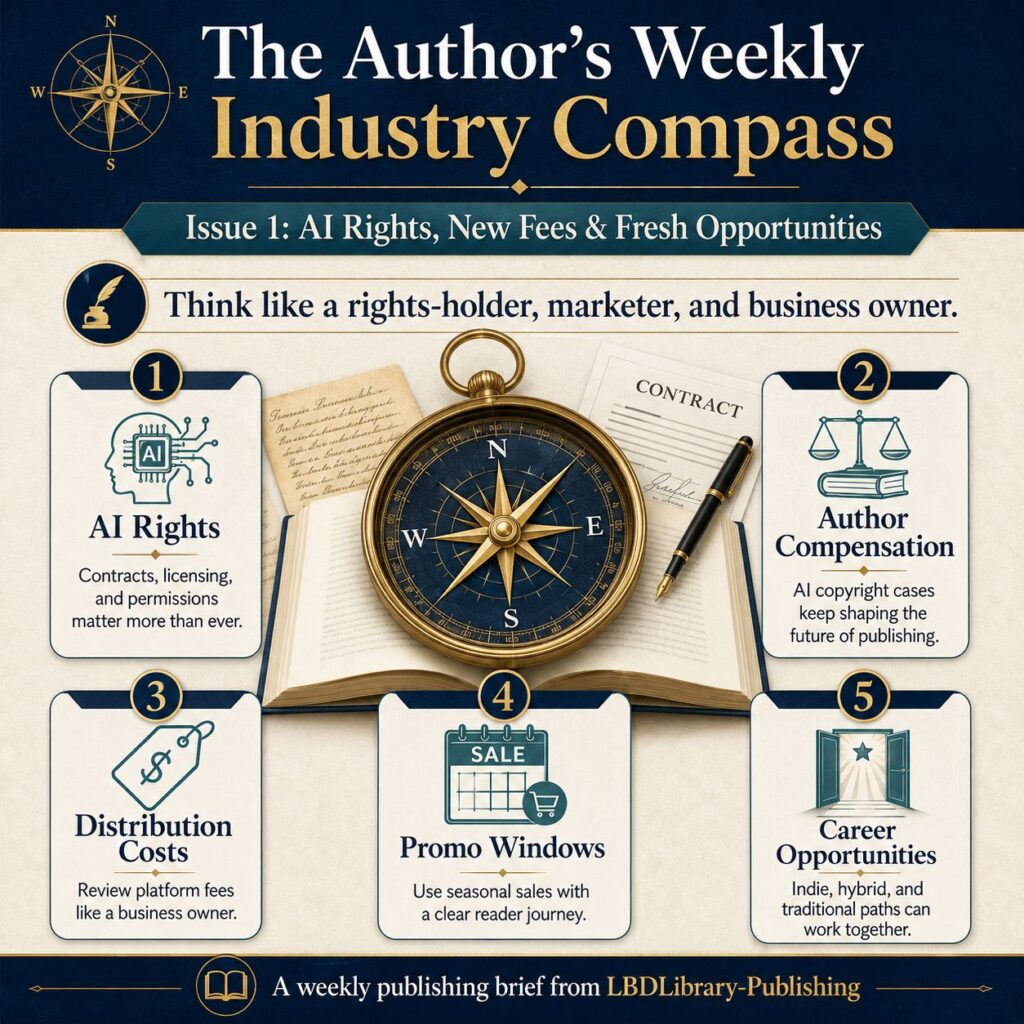
For indie authors, hybrid authors, and traditionally published writers, the publishing landscape is shifting in several connected ways. AI rights are becoming a serious business issue. Author compensation is being tested in court. Distribution platforms are adjusting their fee structures. Seasonal sales are creating promotional opportunities. And emerging authors still have multiple routes into visibility, whether through indie publishing, traditional channels, or a combination of both.
Welcome to the first blog edition of The Author’s Weekly Industry Compass from LBDLibrary-Publishing — a weekly look at the publishing trends, platform changes, and industry opportunities authors need to know.
This week’s theme is simple:
Authors need to think like rights-holders, marketers, and business owners.
Let’s break down what that means.
AI Rights Are No Longer a Future Problem
For a long time, AI in publishing felt like a debate about the future.
Would AI change writing?
Would publishers use it in editing, design, marketing, or translation?
Would authors need to compete with AI-generated books?
Those questions still matter. But the conversation has moved into more practical territory.
The Book Industry Study Group has launched its 2026 AI survey for the North American publishing industry, while more than 250 UK publishers have joined a collective AI licensing scheme through the Copyright Licensing Agency. Together, these developments suggest that AI-related rights, licensing, permissions, and data usage are becoming part of the everyday business structure of publishing.
For authors, this matters because books are no longer just products sold to readers. They are also pieces of intellectual property that may hold value in licensing discussions, training-data debates, and future platform agreements.
That means authors need to pay closer attention to the language around rights.
When you sign a publishing contract, use a distribution service, join a writing platform, or accept terms from a technology provider, the fine print may matter more than ever. Clauses around AI training, machine learning, data usage, derivative works, licensing, or content reuse could have long-term implications.
This is especially important for hybrid authors. A writer may self-publish some books, traditionally publish others, use freelance services, experiment with AI tools, and distribute through several platforms. Each of those choices may involve different rights, permissions, and terms.
The practical takeaway: authors should become more rights-aware. Not fearful. Not frozen. Just more deliberate.
Read more: https://selfpublishingadvice.org/bisg-launches-2026-ai-survey/
Your Book Is Content — But It Is Also an Asset
Authors are often encouraged to think of their books as content.
That is not wrong.
A book can generate newsletter topics, blog posts, podcast interviews, reader magnets, social media snippets, workshops, courses, videos, bonus material, and speaking opportunities. From a marketing perspective, a book is often the center of a much larger content ecosystem.
But in the AI era, authors need to go beyond that.
Your book is not just content. It is intellectual property.
That distinction matters.
Content is something people consume. Intellectual property is something you own, protect, license, adapt, sell, and build upon.
A manuscript can become an ebook, paperback, hardback, audiobook, translation, serialized edition, workbook, course, screenplay, stage adaptation, or merchandise line. A nonfiction framework can become consulting material, training content, or a paid community. A fictional universe can support sequels, spin-offs, character licensing, games, audio drama, or other derivative works.
This is why authors should not treat rights as a dry legal detail.
Rights are business assets.
When authors give away rights too broadly, fail to track their agreements, or ignore new clauses in contracts and platform terms, they may limit future options without realizing it.
Before signing or agreeing to anything, authors should ask:
What rights am I granting?
How long does this agreement last?
Is the permission exclusive or non-exclusive?
Can my work be used for AI training, machine learning, or automated content generation?
Can I opt out?
Can the other party sublicense my work?
Do I retain translation, audio, film, merchandising, or future-format rights?
What happens if the company is sold or the platform changes its terms?
Not every author needs to become a legal expert. But every author should understand that their work has value beyond the initial book sale.
The authors who thrive over the next few years will not necessarily be those who reject every new tool or every new model. They will be the authors who understand what they own, what they are giving away, and what they want to control.
Smart publishing has always required creativity.
Now it also requires rights awareness.
Author Compensation and AI Training Are Still Being Tested
The legal and ethical fight over AI training data continues.
More than 100 authors are reportedly seeking over $75 million from Anthropic, alleging the company used pirated books in connection with AI training. The case is part of a much wider debate about how AI companies source training material, whether copyrighted works were used without permission, and what compensation should look like for authors and rights holders.
For working authors, this is not just a technology story. It is a compensation story.
Books take time, skill, research, editing, and investment. Whether an author is traditionally published or self-published, the finished work represents labor and ownership. If that work is used to train commercial AI systems, authors understandably want clarity, permission, and payment.
These lawsuits and claims may take time to resolve, and outcomes may vary. But the direction of travel is clear: authors, publishers, agents, and rights organizations are increasingly challenging the idea that books can simply be absorbed into AI systems without meaningful accountability.
So what should individual authors do?
First, keep organized records of your work. Maintain files for contracts, publication dates, ISBNs, copyright registrations where applicable, rights reversions, licensing agreements, and platform terms.
Second, understand which rights you control and which rights may already be assigned elsewhere.
Third, stay informed. This area is moving quickly, and legal outcomes may influence future publishing contracts, AI clauses, licensing schemes, and collective rights management.
The practical takeaway: documentation matters. When rights and compensation are contested, authors with clear records are in a stronger position.
Read more: https://theprint.in/feature/100-authors-sue-anthropic-pirating-books-demand-75-million/2979127/
Distribution Costs Are Part of Your Publishing Strategy
AI is not the only area where authors need to think like business owners.
Distribution also deserves attention.
Draft2Digital has introduced new fees in 2026, including a $20 one-time activation fee for new accounts when distribution is turned on. ALLi has noted that existing Draft2Digital account holders are not charged that activation fee, while earlier coverage also reported a $12 annual maintenance fee for low-earning accounts.
For many authors, Draft2Digital remains a useful and author-friendly distribution option. It helps writers publish wide to multiple retailers without managing each storefront separately.
But the fee changes are a good reminder that publishing platforms are businesses too. Their pricing, policies, and incentives can change.
That does not mean authors should panic or rush to leave a platform. It does mean authors should review whether their distribution setup still makes sense.
Wide publishing can be powerful. It allows authors to reach readers beyond Amazon, build a more diversified income stream, and reduce dependence on one retailer. But wide publishing works best when authors actively support it.
Ask yourself:
Are my wide sales covering my platform costs?
Are my books correctly linked across retailers?
Are my series pages optimized?
Have I updated my metadata recently?
Am I promoting non-Amazon purchase options to readers?
Do I understand which retailers are actually generating sales?
Would direct uploads make sense for some platforms?
Is convenience worth the cost for my current author business?
For newer authors, a small activation fee may simply be part of the cost of doing business. For low-earning accounts, maintenance fees may encourage a more serious review of whether books are being actively marketed.
The deeper issue is not one specific fee.
The deeper issue is that authors need to know their numbers.
A book business does not have to be complicated, but it should be monitored. Authors should understand income, expenses, royalty rates, advertising costs, production costs, platform fees, and promotional returns.
The practical takeaway: wide distribution can still be a smart strategy, but “set it and forget it” is rarely enough.
Read more: https://selfpublishingadvice.org/what-the-draft2digital-fee-changes-mean-for-you-in-2026/
Seasonal Sales Can Help Authors Create Momentum
Promotional windows still matter.
The 18th Annual Smashwords Summer/Winter Sale began July 1 and runs throughout the month, giving indie authors a built-in opportunity to discount books and reach deal-seeking readers. Draft2Digital has also provided sample email and social copy for authors participating in the sale.
This kind of event can be especially useful for authors with a backlist.
A single discount may not transform an author career. But when used strategically, a sale can help increase visibility, attract new readers, support series read-through, and give authors a reason to contact their audience.
The key word is strategically.
Discounting works best when there is a clear reader journey.
For example, an author with a five-book series might discount Book 1 to attract new readers, then rely on strong back matter, retailer links, and newsletter follow-up to encourage readers to continue with the rest of the series.
A nonfiction author might discount an introductory book while pointing readers toward a course, consulting offer, paid newsletter, or related workbook.
A children’s author might tie the sale to summer reading, school holidays, family activities, or gift buying.
A romance, fantasy, mystery, or thriller author might use the promotional period to push a completed series, box set, or new release.
A sale is not just about lowering the price. It is about giving readers a timely reason to act.
Authors can make seasonal promotions stronger by preparing a simple campaign:
Update the book description before the sale.
Check that the cover still fits the genre.
Improve the first pages and back matter.
Send a reader newsletter announcing the discount.
Create social posts with clear buy links.
Mention the discount in relevant communities where promotion is allowed.
Track sales and read-through after the event.
Follow up with readers once the sale ends.
The biggest mistake is treating a sale as a passive event. Uploading a discount and hoping readers find it is rarely enough.
The practical takeaway: sales work best when they are part of a plan. Give readers a clear reason to buy now — and a clear next step after they finish.
Read more: https://draft2digital.com/blog/the-2026-summer-winter-sale-at-smashwords/
Emerging Authors Should Keep Looking for Industry Doors
It is easy for indie authors to assume that traditional publishing opportunities are irrelevant to them.
That is not always true.
The Bookseller’s emerging-author coverage highlights the fact that competitions, mentorships, prizes, industry programs, agent opportunities, and visibility initiatives still matter for many writers.
An author career does not have to follow one path.
Some writers begin traditionally and later self-publish. Others start as indie authors and later sign rights deals. Some remain fully independent. Others become hybrid authors, choosing different routes for different projects.
The most successful path is often the one that fits the author’s goals, genre, rights position, audience, and business model.
For emerging authors, opportunities can serve different purposes.
A competition may provide credibility.
A mentorship may help develop craft and industry knowledge.
An agent showcase may open doors to traditional publishing.
A grant may provide time or resources.
A prize listing may support marketing.
An industry event may create useful connections.
A publishing program may help an author understand the business more clearly.
Indie authors should not ignore these opportunities simply because they are building direct publishing careers. Traditional recognition and indie publishing can support each other.
For example, an indie author who wins or places in a respected competition may use that recognition in marketing copy, media outreach, retailer descriptions, and reader communications. A nonfiction author who builds an independent platform may become more attractive to traditional publishers. A traditionally published author may use indie publishing to release niche, experimental, or rights-reverted work.
The point is not to chase every opportunity.
The point is to stay alert to the ones that fit your current stage.
The practical takeaway: publishing careers are increasingly flexible. Authors can build momentum across indie, traditional, and hybrid routes.
Read more: https://www.thebookseller.com/comment/news-for-emerging-authors-june-2026
What Authors Should Do This Week
This week’s publishing updates may seem separate at first glance: AI rights, author lawsuits, platform fees, seasonal sales, and emerging-author opportunities.
But they all point toward the same larger lesson.
Authors need to be proactive.
Not overwhelmed. Not reactive. Proactive.
A proactive author reviews contracts before signing them.
A proactive author keeps rights records organized.
A proactive author watches platform changes.
A proactive author understands distribution costs.
A proactive author plans promotions instead of improvising them.
A proactive author looks for opportunities that match their goals.
Here are five practical actions authors can take this week:
1. Review Your Rights Position
Check your publishing contracts, service agreements, and platform terms. Look for language around AI, licensing, sublicensing, derivative works, exclusivity, and content usage.
You do not need to solve everything immediately. Start by knowing what you have agreed to.
2. Organize Your Publishing Records
Create or update a simple rights and publishing folder. Include contracts, ISBNs, publication dates, copyright information, retailer links, contributor agreements, cover licenses, editing agreements, and rights reversion notices.
Good records make future decisions easier.
3. Check Your Distribution Costs
Look at your sales across platforms. Are your books earning where they are distributed? Are you actively promoting wide links? Are there fees or policies you need to account for?
Distribution is not just a technical choice. It is a business choice.
4. Plan One Promotion With a Clear Goal
If you are participating in a sale, decide what success looks like.
Do you want more first-in-series downloads?
More newsletter subscribers?
More reviews?
More read-through?
More visibility for a new release?
A promotion without a goal is difficult to measure.
5. Identify One Opportunity Worth Pursuing
Look for one competition, mentorship, speaking opportunity, guest post, podcast, grant, reader event, or industry program that fits your current author stage.
One well-matched opportunity is better than ten random ones.
Final Thought: Control Is the Author Advantage
Publishing will keep changing.
AI policy will evolve. Lawsuits will continue. Platforms will adjust fees. Retailer algorithms will shift. Promotional tactics will rise and fade. New opportunities will appear, and old ones will become less useful.
Authors cannot control all of that.
But they can control how informed they are.
They can control their records.
They can control their contracts.
They can control their promotional planning.
They can control their platform choices.
They can control how seriously they treat their books as business assets.
That is the real message of this week’s industry compass.
Your writing is creative work.
Your books are intellectual property.
Your publishing career is a business.
The more clearly authors understand all three, the better positioned they will be to create, market, publish, and sell more books.
The Author’s Weekly Industry Compass is published by LBDLibrary-Publishing to help indie and traditionally published authors stay informed, make smarter publishing decisions, and build stronger author careers.
For weekly publishing news, platform updates, marketing insights, and practical author takeaways, follow LBDLibrary-Publishing and subscribe to The Author’s Weekly Industry Compass.
Discover more from
Subscribe to get the latest posts sent to your email.