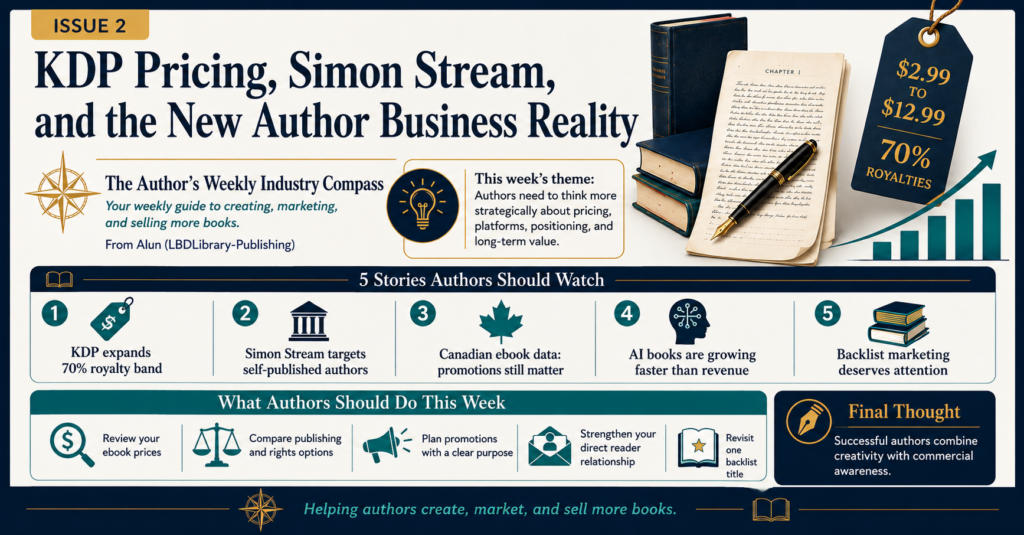

KDP Pricing, Simon Stream, and the New Author Business Reality
Publishing has always required authors to make creative decisions.
But increasingly, it also requires authors to make smart business decisions.
For indie authors, hybrid authors, and traditionally published writers, the latest publishing updates point toward one clear message: authors need to think more strategically about pricing, platforms, positioning, and long-term value.
Amazon has expanded the 70% royalty pricing band for KDP ebooks. Simon & Schuster UK has launched a digital-first imprint aimed at self-published authors. Canadian ebook data shows that price and promotions still influence readers. New research is examining how AI-generated books may affect the self-published fiction market. And BookBub’s latest author marketing guidance reminds writers that their backlist may still have far more value to unlock.
Together, these stories show how the author business is changing.
Let’s break down what authors should take from them.
KDP’s Expanded 70% Royalty Band Gives Authors More Pricing Room
Amazon has expanded the KDP 70% ebook royalty option on Amazon.com to cover ebooks priced from $2.99 to $12.99, increasing the previous upper limit of $9.99.
At first glance, that may sound like a technical pricing-policy update.
But for authors, it could be more significant than it appears.
This change gives authors more flexibility to price certain ebooks higher while still qualifying for the 70% royalty option. That may be useful for authors publishing:
Premium nonfiction
Box sets
Omnibus editions
Longer ebooks
Specialist resources
Heavily illustrated ebooks
Educational or professional titles
Previously, many authors who priced ebooks above $9.99 had to accept a lower royalty structure. The expanded band creates more room for authors to test higher-value pricing while still preserving a stronger royalty percentage.
That does not mean every author should raise prices.
It does mean every author should review their catalog and ask whether their current pricing still makes sense.
A short genre-fiction novel may not benefit from a higher price. A first-in-series title may perform better as an accessible entry point. But a nonfiction book that solves a valuable problem, a complete box set, or a specialist guide may be underpriced if it is delivering strong reader value.
The key is not to price higher just because the option exists.
The key is to price with intention.
Author takeaway: review your ebook pricing, especially for nonfiction, box sets, premium titles, and longer works. The expanded KDP royalty band gives authors more room to experiment, but pricing should always match reader expectations and perceived value.
Read more: https://kdp.amazon.com/en_US/help/topic/G200634560
Pricing Is Not Just a Number
Many authors treat pricing as a technical decision.
What does Amazon allow?
What are other authors charging?
What price will qualify for the best royalty rate?
Should the book be $2.99, $4.99, $6.99, $9.99, or higher?
Those questions matter.
But pricing is not only about the number on the buy button.
Pricing is positioning.
A low price can communicate accessibility, urgency, or a limited-time promotion. A higher price can communicate depth, authority, specialist knowledge, or premium value.
Neither approach is automatically right or wrong.
The right price depends on the book, the reader, the category, the author’s goals, and the wider publishing strategy.
For fiction authors, pricing often connects to read-through. A discounted first-in-series book may be designed to bring new readers into a larger catalog. A box set may justify a higher price because it offers clear bundled value. A standalone novel may need to sit closer to reader expectations in its genre.
For nonfiction authors, pricing often works differently. A book that helps readers solve a business, financial, professional, creative, health, or personal problem may carry more perceived value than a short entertainment read. If the book also supports consulting, speaking, courses, coaching, or authority-building, the price may influence how readers perceive the author’s expertise.
This is why the KDP royalty-band expansion matters.
It gives authors more room to test premium pricing without immediately falling outside the 70% royalty option on Amazon.com.
But flexibility should not be confused with permission to guess.
Before changing your pricing, ask:
Does this book deliver enough value to justify a higher price?
Is it fiction, nonfiction, a box set, or a specialist resource?
How does the price compare with similar books in the category?
Will a higher price reduce sales volume but increase profit?
Could a lower price improve visibility, reviews, or read-through?
Is this book designed to sell directly, support a funnel, or build authority?
Will the price make sense to readers seeing the book for the first time?
Authors should also remember that pricing is not permanent.
A launch price may not be the right long-term price. A backlist book may benefit from a temporary promotion. A premium nonfiction title may justify a higher price once reviews, positioning, and authority are in place.
The smartest authors do not price emotionally.
They price deliberately.
They understand the relationship between royalty rate, reader expectation, genre norms, promotional goals, and long-term author business strategy.
The expanded KDP band is not just a royalty update.
It is an invitation to think more carefully about what your books are worth — and how your pricing supports the author career you are building.
Simon & Schuster UK’s Simon Stream Shows How Hybrid Publishing Is Evolving
Simon & Schuster UK and International has launched Simon Stream, a digital-focused fiction imprint aimed at self-published authors who want some of the benefits of traditional publishing without following the traditional advance model.
The imprint says it is not a self-publishing service and that authors do not pay to be published. Instead of an advance, Simon Stream offers 50% ebook royalties, paid monthly, along with support that may include editorial partnership, metadata optimization, digital marketing, pricing activity, retailer promotions, NetGalley campaigns, and rights expertise.
This is worth watching because it shows that major publishers are paying closer attention to the strengths of the indie publishing model.
Self-publishing has changed author expectations.
Many authors now care deeply about:
Higher royalty rates
Faster publishing timelines
Digital-first strategies
Greater transparency
More frequent royalty payments
Stronger control over career decisions
Flexible routes to market
Simon Stream appears to respond to some of those expectations by combining elements of traditional publishing with features that may appeal to commercially minded self-published authors.
For authors, the important point is not whether this specific imprint is right for them.
The important point is that publishing models are becoming more varied.
The old question used to be:
Should I self-publish or traditionally publish?
Now, the better question may be:
Which publishing route makes the most sense for this specific book, at this specific stage of my career, under these specific terms?
A hybrid author might self-publish one series, license audio rights separately, work with a traditional publisher for another project, sell direct from their website, and consider a digital-first imprint for a particular genre or territory.
That flexibility can be powerful.
But it also requires careful evaluation.
Author takeaway: when new publishing models appear, compare the full deal. Look at royalty rates, rights, contract length, marketing support, exclusivity, payment schedule, creative control, reversion terms, and long-term career fit.
Read more: https://www.simonandschuster.co.uk/p/simon-stream
Canadian Ebook Data Shows Promotions Still Influence Readers
BookNet Canada’s 2025 ebook study reports that 34% of Canadian book buyers bought ebooks in 2025, while 29% of Canadian book borrowers borrowed ebooks.
The study also points to the continued importance of pricing, offers, and promotions in ebook buying behavior.
That matters for authors because ebook readers remain responsive to value.
Value does not always mean cheap.
It can mean convenience, timing, relevance, bundle pricing, a strong recommendation, a useful offer, or a clearly positioned book that feels worth buying now.
For indie authors especially, promotions remain one of the most flexible tools available.
Authors can test:
Limited-time discounts
First-in-series offers
Seasonal campaigns
Ebook bundles
Direct-sales promotions
Newsletter-led campaigns
Retailer-specific pricing
Backlist refresh promotions
But promotions work best when they are connected to a clear reader journey.
A discount without a strategy is just a lower price.
A discount connected to read-through, reviews, list-building, direct sales, or backlist discovery is a business tool.
For example, a fiction author might discount Book 1 in a series to attract new readers and then guide them toward the rest of the series through strong back matter and email follow-up.
A nonfiction author might discount an entry-level book while pointing readers toward a workshop, consulting offer, paid newsletter, or related resource.
A children’s author might connect a promotion to school holidays, family reading, or gift buying.
The price is only one part of the promotion.
The real question is what happens after the reader buys.
Author takeaway: promotions still matter, but they should serve a purpose. Decide whether your promotion is designed to increase sales, grow your list, generate reviews, support read-through, or revive a backlist title.
Read more: https://www.booknetcanada.ca/scrolling-stories-ebook-use-in-canada-2025
AI-Generated Books May Be Increasing Market Noise
A new research paper analyzing more than 14,000 self-published genre-fiction books sold on Amazon from 2023 to 2026 argues that AI-generated books are increasing catalog volume faster than overall revenue growth.
The paper suggests that the number of books with observed sales in a quarter grew much faster than quarterly revenue, meaning more books may be entering the market without a proportional increase in reader spending.
Because this is a preprint, authors should treat it as research to watch rather than settled industry fact.
But the concern behind it will feel familiar to many writers.
The market is getting noisier.
More books are being published. More content is competing for reader attention. More authors are fighting for visibility. AI tools may make it easier for low-effort books to enter already crowded categories.
That does not mean serious authors should panic.
It does mean serious authors need to differentiate.
If readers are surrounded by more content, trust becomes more valuable.
Human authors can compete by building things that are harder to fake:
A distinctive voice
A recognizable author brand
Strong reader relationships
Consistent quality
Clear genre positioning
Better covers and descriptions
A trusted newsletter or community
Authentic expertise in nonfiction
Emotional connection in fiction
Marketplace visibility alone is becoming a weaker foundation.
Authors who rely entirely on retailer algorithms may find it harder to stand out. Authors who build direct relationships with readers may be more resilient.
That could mean developing an email list, creating a stronger website, building a social presence, using reader magnets, improving metadata, encouraging reviews, or creating a more consistent author identity across platforms.
The goal is not to shout louder than everyone else.
The goal is to become easier for the right readers to recognize, trust, and remember.
Author takeaway: as the market gets noisier, reader trust becomes an advantage. Build a brand and relationship that gives readers a reason to choose your work over the flood of alternatives.
Read more: https://arxiv.org/abs/2607.20349
Your Backlist Is Not Finished Working
BookBub’s author marketing guidance is a timely reminder that older books can still generate value long after launch week.
Many authors focus heavily on the next release.
That is understandable. New books are exciting. Launches create urgency. A fresh title gives authors something new to talk about.
But the books you have already published may still be underused assets.
A backlist can support:
New reader discovery
Series read-through
Seasonal promotions
Newsletter growth
Social media content
Bundles and box sets
Audiobook campaigns
Retailer promotions
Reader re-engagement
Direct-sales offers
The key is to stop thinking of backlist titles as old.
To most readers, your older book is only old if they have already seen it.
A novel published three years ago may be brand new to a reader discovering you today. A nonfiction book may still be useful if the advice remains relevant. A series starter may still be the best entry point into your catalog. A backlist title may perform better after a new cover, sharper book description, stronger keywords, or a coordinated promotion.
Before rushing into the next launch, authors should ask what their existing books could be doing better.
Could the cover be improved?
Could the description be clearer?
Could the categories be updated?
Could the back matter guide readers to the next book?
Could the book be included in a bundle?
Could it support a seasonal campaign?
Could it be promoted to newsletter subscribers who joined after launch?
Could it be used as a reader magnet, discount offer, or direct-sales product?
Your backlist is not just a record of what you have published.
It is part of your author business.
Author takeaway: choose one older title and review it as if you were launching it today. Small improvements can create new momentum.
Read more: https://insights.bookbub.com/ideas-more-value-backlist-books/
What Authors Should Do This Week
This week’s publishing updates all point toward the same practical message:
Treat your author career like an evolving business.
Here are five actions worth considering.
1. Review Your Ebook Prices
Look across your catalog and identify any titles that may benefit from the expanded KDP 70% royalty pricing band.
Pay special attention to nonfiction, box sets, specialist books, premium ebooks, and longer works.
Do not change prices blindly. Compare similar books, consider reader expectations, and decide what each title is meant to achieve.
2. Recheck Your Rights and Publishing Options
Simon Stream is another sign that the line between indie and traditional publishing continues to blur.
That creates opportunity, but it also creates complexity.
Before signing any new deal, compare the full agreement. Royalty percentage matters, but so do rights, exclusivity, payment terms, marketing support, reversion clauses, and long-term control.
3. Plan Your Next Promotion With a Purpose
Promotions work best when they are designed around a specific outcome.
Do you want more sales?
More read-through?
More reviews?
More email subscribers?
More attention for a backlist title?
More direct buyers?
Decide the goal before choosing the discount.
4. Strengthen Your Reader Relationship
If AI-generated books are increasing market noise, authors need trust and recognition.
A direct reader relationship is one of the strongest assets an author can build.
That may come through a newsletter, website, reader group, podcast, social presence, direct-sales platform, or consistent author brand.
5. Revisit One Backlist Book
Choose one older title and review it carefully.
Look at the cover, description, categories, keywords, pricing, reviews, back matter, retailer links, and promotional history.
Ask one simple question:
What would I improve if I were launching this book today?
Final Thought: Value Is the Author Advantage
This week’s theme is value.
The value of your pricing.
The value of your rights.
The value of your backlist.
The value of reader trust.
The value of understanding how platforms and publishers are changing.
Authors do not need to chase every trend.
But they do need to understand which changes affect their books, income, visibility, and long-term opportunities.
Publishing is still creative work.
But increasingly, successful authors are the ones who combine creativity with commercial awareness.
Your books are not just creative projects.
They are assets.
The more deliberately you manage those assets, the stronger your author career can become.
The Author’s Weekly Industry Compass is published by LBDLibrary-Publishing to help indie and traditionally published authors stay informed, make smarter publishing decisions, and build stronger author careers.
For weekly publishing news, platform updates, marketing insights, and practical author takeaways, follow LBDLibrary-Publishing and subscribe to The Author’s Weekly Industry Compass LinkedIn newsletter Here.
Discover more from
Subscribe to get the latest posts sent to your email.