
Why Authors Now Need to Prove Their Process, Protect Their Rights, and Track Their Income
Writing a good book is still at the heart of being an author. But the publishing stories making news in 2026 show that the work surrounding the manuscript is becoming just as important.
Authors may now be asked how a book was created, especially when artificial intelligence is suspected. Those choosing hybrid publishing can invest thousands before a book reaches readers, making the wording of the contract critical. Royalty percentages can sound generous while producing disappointing payments if they are calculated from heavily discounted receipts. Meanwhile, audiobook subscriptions are expanding and turning audio rights into a more valuable part of an author’s portfolio.
These developments share one lesson: authors need to manage their work as intellectual property, not merely as a finished document.
Manuscript Provenance Is Becoming Part of Publishing
In July 2026, a major deal for Jerry Falade’s debut crime novel collapsed after his agents said they could no longer authenticate how the manuscript had evolved. The author denies using AI and has argued that racial bias played a part in the accusations. The agency did not rely on AI-detection software, according to reporting, but eventually withdrew the book after losing confidence in the account it had received. The Guardian reported that the manuscript had attracted an offer exceeding $2 million.
It is important not to turn one disputed case into a general presumption that unusual writing must be machine-generated. AI detectors can be unreliable, and false accusations can cause serious personal and professional harm. At the same time, agents and publishers face commercial, legal, and reputational questions when they cannot establish the origins of a manuscript.
The practical response for authors is to preserve evidence of their own process.
Useful records include dated drafts, cloud version histories, handwritten notes, research files, tracked editorial changes, and correspondence with beta readers or editors. Authors who use AI tools should also record which tool was used, what task it performed, and how the output was checked or rewritten.
This does not mean every writer needs to submit a creative audit with a manuscript. It means reliable evidence will exist if a reasonable question is raised.
AI Disclosure Needs a Personal Policy
Many writers do not describe their work as “AI-generated,” but they may still use AI for research prompts, idea organization, grammar suggestions, advertising copy, or metadata. Different publishers, contests, platforms, and readers may draw the line in different places.
An author’s personal AI policy can answer four simple questions:
- Which uses are acceptable during planning and research?
- Can AI-generated wording appear in the final manuscript?
- How will factual suggestions be verified?
- What will be disclosed to an agent, publisher, platform, or reader?
Writing these answers down creates consistency. It also prevents rushed decisions when a submission form suddenly asks about AI use.
Hybrid Publishing Requires Commercial Due Diligence
Hybrid publishing sits between traditional publishing and author-managed self-publishing. A hybrid publisher typically supplies services such as editing, design, production, distribution, and marketing while asking the author to contribute a substantial upfront payment.
That model can suit some authors, particularly those who value professional support and are prepared to finance publication. It can also expose authors to high costs, vague marketing promises, weak sales reporting, and rights that are difficult to recover.
The Authors Guild advises writers to investigate both the publisher and the agreement. Its guidance notes that authors who fund publication should generally receive much higher royalties than under a traditional publishing arrangement and says hybrid royalties commonly exceed 50% of net receipts. The complete Authors Guild guide explains the clauses and warning signs in more detail.
Before signing, an author should obtain clear answers to questions such as:
- What exact work is included in the fee?
- Which marketing activities are guaranteed, rather than merely possible?
- Who approves the cover, edits, price, and metadata?
- Who owns the ISBN and production files?
- How often are sales reported and royalties paid?
- Which costs can be deducted before the author’s share is calculated?
- What happens to the files, inventory, and rights when the agreement ends?
If the answers are not written into the agreement, they may be difficult to enforce later.
A Royalty Percentage Is Only Half the Calculation
Authors frequently compare contracts by looking at the royalty percentage. That number is useful only when the calculation behind it is understood.
The Polish Literary Union is campaigning for a statutory minimum royalty of 10% of a book’s cover price. The organization argues that royalties based on discounted selling prices leave writers vulnerable and make earnings unpredictable. Some publishers have warned that a mandatory minimum could place additional strain on small literary presses. Publishing Perspectives outlines both sides of the Polish debate.
The debate illustrates a wider contract lesson. Ten percent of a £20 cover price produces £2. Ten percent of the publisher’s £8 net receipt produces 80p. Further deductions can reduce the author’s payment again if the contract permits them.
When reviewing a royalty clause, authors should identify:
- Whether the percentage is based on list price, selling price, or net receipts.
- How “net receipts” is defined.
- Which discounts, taxes, returns, fees, or production costs may be deducted.
- Whether the rate changes by format, territory, sales volume, or retailer.
- Whether sublicensing income uses a different split.
The headline rate matters. The base and deductions often matter more.
Audiobook Rights Need Their Own Strategy
Audio is not simply another file format. It has separate production costs, performers, licenses, distributors, territories, and payment models.
BookBeat, a Swedish audiobook subscription service operating across several European markets, reported a 13% increase in revenue during the first half of 2026. Germany was its strongest-performing market, while Poland contributed the largest number of new users. Publishing Perspectives also reported double-digit growth in paying users.
These results do not guarantee that every book will succeed in audio. They do show that audiobook discovery is increasingly international and subscription-led.
Before licensing audio rights, authors should consider whether the agreement is exclusive, which countries and languages it covers, how subscription listening is paid, how long the license lasts, and whether rights return if the audiobook is not produced or actively sold.
Indie authors should also compare the likely cost of narration and production against the size of the audience. A backlist series may justify investment more easily than a single short book. Some nonfiction authors may find that a direct, author-narrated edition strengthens their personal brand. The right choice depends on the book and business model, but the decision should be deliberate.
Build a Publishing Evidence File
The simplest way to connect all these responsibilities is to maintain one publishing evidence file for each book.
It can contain manuscript versions, research notes, AI-use records, contracts, rights schedules, royalty statements, service-provider invoices, marketing deliverables, and licensing correspondence. A basic spreadsheet can track who controls each right, the territory, the term, the payment basis, and any date when rights can be reviewed or recovered.
This record reduces uncertainty. It gives an author evidence of the writing process, makes royalty checks faster, and prevents valuable rights from being forgotten inside an old agreement.
Professional Authorship Now Includes Record-Keeping
Good administration will never replace good writing. It protects the conditions that allow writing to remain a sustainable business.
Authors who document their process are better prepared for questions about AI. Those who read contracts carefully are less likely to lose control of their work. Those who understand royalty calculations can compare offers realistically. And those who track audio and other subsidiary rights can make informed decisions as new markets grow.
The modern author does not need to control every part of publishing alone. But every author should know what has been created, what has been promised, what has been licensed, and what has been paid.
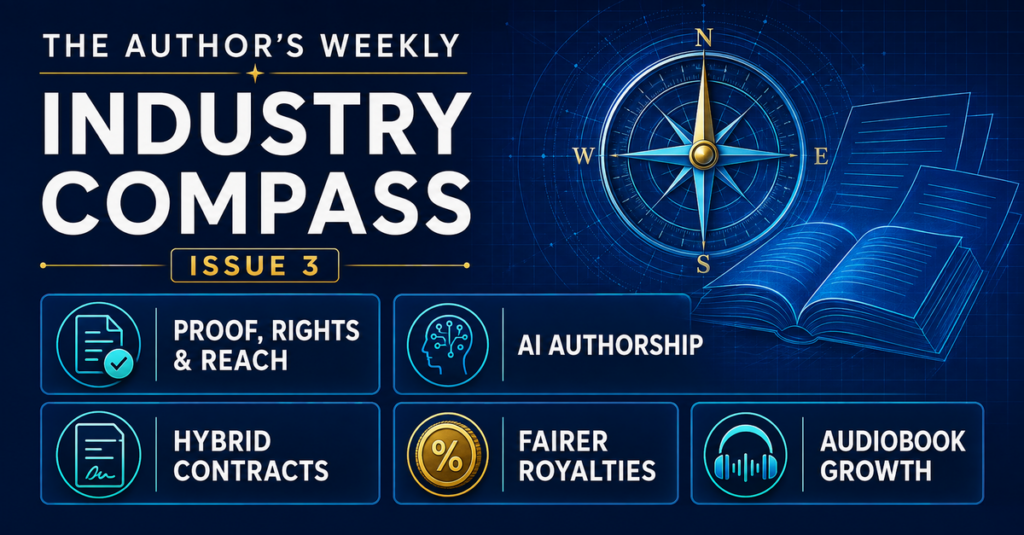
For more practical publishing developments and clear author takeaways, read and subscribe to
The Author’s Weekly Industry Compass newsletter on LinkedIn Here.
Discover more from
Subscribe to get the latest posts sent to your email.