
Some publishing news changes what you should do. Some of it simply gives you another headline to worry about.
The difficult part is telling the difference.
The most useful publishing trends for authors are not necessarily the loudest stories. They are the developments that help you make a clearer decision about your book, your readers, your rights, your partners, or your income.
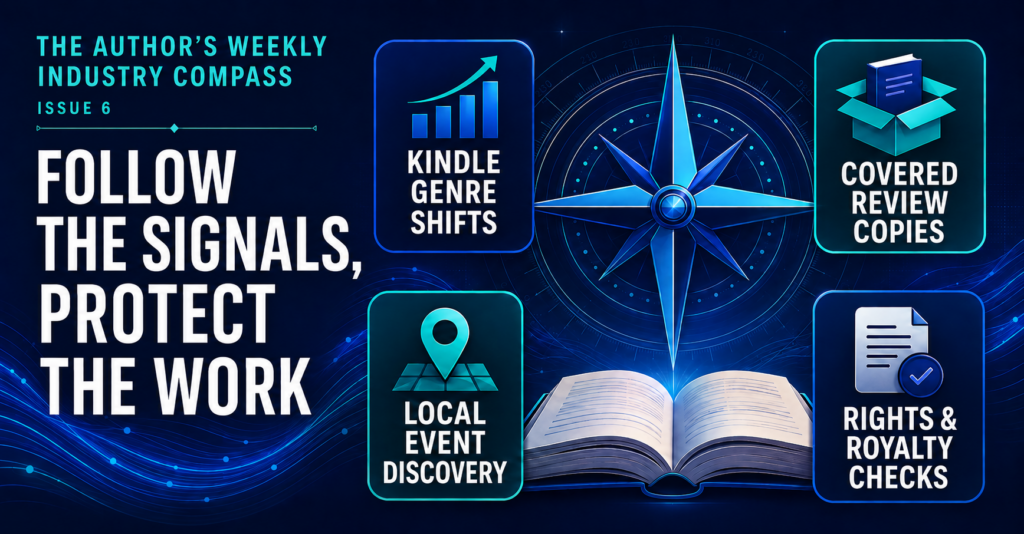
That is the thread running through Issue 6 of The Author’s Weekly Industry Compass. Kindle genre shares are moving. Ingram has launched a new professional review-copy platform. A local-event service is trying to improve literary discovery. Independent bookshops are warning about rising costs. Rights work is becoming more continuous and technology-supported. Authors are bringing new copyright claims involving AI, while royalty transparency remains a practical concern.
These stories may look unrelated. Together, they point toward one useful working principle:
Follow real market and partner signals, but protect your decisions with accurate records.
You do not need to react to every development this week. You can use the seven sections below to decide which one deserves attention in your own author business.
1. Use Genre Data to Question Your Positioning
On August 19, 2026, Jane Friedman reported on K-lytics analysis showing that romance remained the leading Kindle genre in the United States, while its share had fallen and mystery, thriller, and suspense had gained. Read Friedman’s report summary.
It is tempting to turn that into a simple instruction: write less romance, write more mystery.
That would be a poor use of the information.
A bestseller share is a market signal, not a writing assignment. It reflects one store, one measured period, the books available during that period, and the way categories were defined. It does not tell you whether your particular romantic suspense series, cozy mystery, historical romance, or psychological thriller will find readers.
What the signal can tell you
Market movement gives you a reason to inspect current reader expectations more closely.
Look at 10–20 recently successful books that genuinely sit beside yours. Do not choose global bestsellers simply because you recognize the names. Choose books that share your subgenre, audience, tone, price area, format, and publishing route.
Record:
- Cover style and dominant visual promise;
- Title and subtitle patterns;
- Description opening;
- Main trope, problem, or reader benefit;
- Length and format;
- Price;
- Series position;
- Publication frequency;
- Review language; and
- The expectation created before purchase.
You are not looking for elements to copy. You are looking for the current language of the shelf.
A fiction example
Suppose you write a gentle small-town mystery. You notice that several current competitors emphasize community, humor, and recurring relationships more strongly than the crime itself. Your book already contains those qualities, but your cover and description present it as a dark police procedural.
The useful decision is not to change genre. It is to make the existing reader experience visible.
You might revise the description opening, choose more accurate categories, or test a cover direction that better signals tone. The manuscript stays the same; the promise becomes clearer.
A nonfiction example
Suppose your leadership book is listed broadly under management, but readers increasingly search for specific problems such as difficult conversations, remote-team trust, or first-time management.
Your research may show that the book needs a more precise subtitle, stronger search phrases, or content that leads with the immediate problem rather than the author’s general expertise.
Again, the trend does not tell you what to write. It helps you ask whether your presentation matches the decision the reader is trying to make.
Your practical action
Create a simple comparison sheet with these columns:
| Comparable book | Reader promise | Cover signal | Description hook | Price/format | Useful lesson |
| [Title] | [Experience/result] | [Visual cue] | [Opening angle] | [Details] | [What to test] |
Choose one evidence-based improvement. Do not rebuild your entire book around one week’s chart.
2. Prepare for Professional Review-Copy Discovery
Ingram launched Covered on August 17, 2026. Its first release focuses on digital review copies, community reviews, team management, and professional profiles for publishers, booksellers, librarians, and other industry professionals. Broader catalog, collection, ordering, and system-integration functions are scheduled for fall 2026, with additional features planned for 2027.
Publishers Weekly reported that the launch included titles from roughly 200 publisher advisers and that Ingram’s iPage network has about 50,000 bookseller and librarian users. It also reported that IngramSpark authors are expected to be able to create a digital review copy through a credit-card checkout. Authors should verify current access, price, terms, and reporting before paying. Read the August 17 launch report.
The opportunity is professional discovery. The risk is assuming that uploading a book creates a campaign.
What a professional needs to decide
A bookseller or librarian is not simply another consumer reviewer. They may be deciding whether the book suits a store, collection, reading group, display, event, classroom, or community.
Prepare a compact trade-facing packet with:
- final cover;
- title, subtitle, author, and imprint;
- ISBNs and formats;
- publication date;
- price;
- precise genre or subject;
- age range where relevant;
- a 50–75-word description;
- two or three accurate comparable titles or audience cues;
- ordering and distribution details;
- trade discount and returns information for bookshop outreach;
- short relevant author biography;
- territory and availability; and
- a clear contact route.
Test the packet on someone who has not read the manuscript. After 30 seconds, can they explain what the book is, who it serves, why it is distinctive, and how to obtain it?
Do not confuse access with fit
A large professional network sounds attractive, but relevance still matters. A librarian serving business researchers needs different evidence from a children’s librarian. A specialist crime bookshop needs a different pitch from a general gift store.
Before offering a copy, complete this sentence:
I am approaching [specific recipient] because this book helps or interests [audience they serve] through [clear fit]. I would like them to consider [appropriate professional action].
If you cannot finish the sentence without vague words such as “exposure,” your targeting needs more work.
Your practical action
Create a professional review-copy folder this week. Include the book sheet, high-resolution cover, secure digital file or delivery method, ordering information, biography, and contact details.
When you are ready to run outreach, use the separate professional review-copy campaign guide for recipient selection, invitation templates, delivery, follow-up, and ethical-review checks.
3. Make Local Author Events Easier to Discover
Also on August 19, Jane Friedman highlighted Lit Circle, a service created by a former Chicago bookstore owner to connect readers with nearby author events and literary programming. Read the report and view Lit Circle’s current listings.
Whether Lit Circle achieves wide local coverage will depend on adoption. The larger lesson already applies: an event cannot help readers if they cannot find it, understand it, or work out how to attend.
Treat the event listing as a small sales page
Many event listings provide a title, date, and address but fail to answer the reader’s real questions.
A useful listing should make these points obvious:
- What is happening? Reading, conversation, workshop, signing, book-club visit, launch, or panel.
- Who is it for? Crime readers, local historians, parents, aspiring writers, business owners, children of a stated age, or another clear group.
- What will the attendee gain? Entertainment, insight, practical help, discussion, community, or access to the author.
- Where and when? Include full date, start and finish time, time zone for online events, address, and room details.
- How do they attend? Booking link, cost, capacity, accessibility information, and contact details.
- Can they get the book? Explain whether books are sold, supplied by a bookshop, available for signing, or optional.
Build a local discovery chain
Do not rely on one Facebook event or one host listing.
For every confirmed event, aim to appear in several appropriate places:
- host website and email newsletter;
- your author website;
- your email list;
- relevant local-event services and community calendars;
- partner bookshop or library channels;
- local media listings where suitable; and
- selected social posts with the booking link.
The wording, date, time, and link should match everywhere. Inconsistent listings create hesitation and support questions.
A reusable event description
Join [author] for [event type] exploring [specific subject or reader interest]. You will [clear attendee benefit] and have an opportunity to [discussion/questions/signing/activity]. The event is designed for [audience]. It takes place at [venue] on [full date and time]. [Price/free status, accessibility, and booking instruction].
Your practical action
Choose one planned or possible event. Audit every public listing against the seven questions above. Ask the host who owns updates and where the final booking data will be published.
If no event is planned, identify one small format you could offer locally: a library discussion, bookshop conversation, specialist workshop, community-history talk, school visit, or reading-group session. A useful local event does not need to look like a national tour.
4. Approach Independent Bookshops as Business Partners
On August 18, The Guardian reported that 234 independent booksellers had signed an open letter seeking business-rates relief for bookshops in England. Authors including Philip Pullman, Maggie O’Farrell, Katherine Rundell, and Elif Shafak supported the campaign. The report described concerns that higher costs could reduce investment in stock, staff, events, and premises. Read the report and its supporting figures.
This is a specific UK policy story, but the author lesson travels: independent bookshops operate with limited space, cash, staff time, and attention.
When you ask a shop to stock your book or host an event, you are asking for a business decision—not a favor owed to a local author.
Complete the bookshop readiness check
Before approaching a store, confirm:
- the cover and interior meet professional expectations;
- the book has an ISBN and accurate metadata;
- the retail price fits the market;
- the book is available through the shop’s preferred supplier or a clearly workable direct route;
- the trade discount is commercially realistic;
- returns terms are clear;
- the shop does not have to manage complicated payment or delivery arrangements;
- you can explain the local, reader, or subject connection; and
- you will actively help promote any agreed event.
These details will not guarantee acceptance. They make the decision easier to assess.
Make a focused approach
Avoid opening with “I’m a local author” and leaving the commercial reasoning unstated.
Try:
I’m a [local connection] author of [title], a [genre/type] for [specific reader]. I thought it might suit your shop because [truthful connection to stock, customers, events, or locality]. It is available through [supplier] at [terms] and publishes on [date]. May I send a one-page information sheet for your consideration?
Respect the answer. A thoughtful “not for us” is better than stock that does not sell or a strained relationship.
Support the shop after a yes
If a shop agrees to stock the book or host you:
- send the correct assets promptly;
- link readers to the shop where possible;
- promote the event to your own audience;
- arrive prepared and on time;
- avoid promising an unrealistic crowd;
- thank the staff privately and publicly; and
- ask how unsold stock or follow-up should be handled.
The long-term goal is a reliable local partnership, not a single photograph of your book on a shelf.
Your practical action
Audit one title against the readiness list. Fix the weakest commercial detail before contacting a bookshop.
5. Manage International Rights Throughout the Year
Publishing Perspectives reported on August 21 that Frankfurt Rights is positioning its service as a year-round platform for rights discovery, contacts, licensing, and permissions rather than a tool used only around the Frankfurt Book Fair. Its Instant Permissions function is intended to support smaller permissions transactions. Read the Frankfurt Rights interview.
Most individual authors will not need a full professional rights platform. The development still reflects an important change in mindset: rights work does not begin and end with one contract or one annual fair.
Know what can be licensed
A book may involve rights in:
- print;
- ebook;
- audio;
- translation;
- named territories and languages;
- large print;
- serial or extract use;
- anthology inclusion;
- quotation and permissions;
- educational or course use;
- dramatic, film, television, or stage adaptation;
- merchandising; and
- emerging technology or AI-related uses.
Ownership varies by contract. Do not advertise or negotiate a right until you know who controls it.
Create a one-page rights inventory
Use one row per title and right:
| Title | Right/format | Territory/language | Status | Licensee | Term/end date | Next action |
| [Book] | [Audio/translation/etc.] | [Area/language] | [Available/licensed] | [Party] | [Date] | [Action] |
Attach or link:
- signed contracts and amendments;
- rights granted and retained;
- exclusivity;
- territory and language;
- start, end, and renewal dates;
- delivery and approval obligations;
- payment and statement schedule;
- reversion conditions;
- contact history; and
- current pitch or sample material.
Prepare a compact rights packet
If you control a right that may be marketable, prepare:
- short title summary;
- author biography;
- publication and sales context you can verify;
- reviews or awards you have permission to cite;
- comparable titles;
- available rights statement;
- translation sample or full manuscript where appropriate; and
- direct contact details.
Do not exaggerate demand or availability. Rights conversations rely on trust and precise scope.
Your practical action
Choose one book and list every format, territory, and licensing right you can identify. Mark each as retained, licensed, unclear, or not applicable. The “unclear” items become questions for your agent, publisher, contract adviser, or qualified lawyer.
This is not legal advice. Rights language can carry significant consequences, so obtain professional advice before signing or interpreting an agreement you do not fully understand.
6. Treat AI Copyright News Carefully and Practically
On August 20, Publishing Perspectives reported that a group of US textbook authors had filed a proposed class action against OpenAI and Microsoft. The complaint alleged unauthorized copying of textbooks for AI training. These are allegations in ongoing litigation, not findings that the defendants are liable. Read the report and its description of the complaint.
That distinction matters. AI and copyright discussions can become distorted when a filed complaint, a judicial ruling, a settlement, a policy proposal, and an enacted law are treated as the same thing.
Use a four-label news test
When you read an AI copyright headline, label it before deciding what it means:
- Allegation: a party claims that something happened.
- Ruling: a court has decided a particular legal question, possibly at an interim stage.
- Settlement: parties have resolved a dispute without necessarily establishing a general legal rule.
- Law or regulation: an authority has adopted a requirement that applies within a defined jurisdiction and date.
Then record the country, court or authority, date, stage, works involved, legal question, and next known step.
This prevents a headline from becoming false certainty.
Audit your own agreements and practices
AI-related risk is not limited to lawsuits between large organizations. Authors should understand:
- What rights they grant to publishers, agents, platforms, editors, designers, narrators, and service providers;
- Whether contracts mention machine learning, model training, data mining, synthetic narration, or broad future-media language;
- Whether a service’s current terms permit submitted material to be used beyond providing the service;
- Whether confidential or unpublished material is protected appropriately;
- What records show when and how a manuscript was created and revised; and
- Whether collaborators consent to the use of tools applied to their work.
Do not assume that a general copyright clause automatically answers a new technology question. Do not assume the absence of an AI clause answers it either.
Keep a simple provenance record
For each project, retain:
- Dated drafts;
- Research notes and source links;
- Editorial correspondence;
- contributor agreements;
- Permissions and licenses;
- Tool and service names used in production;
- Important terms or settings relied upon;
- Human review and revision notes; and
- Final publication files.
This is not about proving that every sentence arrived in one particular way. It is about maintaining an ordinary professional record of how the work was developed and what third-party material or services were involved.
Your practical action
Review one active contract or service agreement. Search for: AI, artificial intelligence, machine learning, training, data mining, license, sublicense, confidential, content, and future media.
Write down what the language appears to allow, what remains unclear, and who can give you qualified advice. Do not rely on a social post for legal interpretation.
7. Build Your Own Royalty Transparency System
Issue 6 also considered the growing demand for clearer rights and royalty information. A sponsored Publishing Perspectives article on August 20 argued that complex licensing and infrequent, inconsistent royalty statements can weaken creator trust, while publisher portals may offer more timely information. Because the piece discusses an Ingenta product, it should be read as a commercial perspective rather than independent evidence that one system solves the problem. Read the sponsored article with that context.
The practical author lesson does not depend on buying a portal: keep records that allow you to understand and question your income.
Start with the contract
For each publishing or licensing agreement, record:
- Accounting periods;
- Statement and payment deadlines;
- Royalty rate by format, territory, or sales channel;
- Calculation base, such as retail price or net receipts;
- Advance and recoupment terms;
- Escalators;
- Discounts and special-sales provisions;
- Reserves against returns;
- Permitted deductions;
- Sublicensing income split;
- Payment threshold;
- Currency and conversion method;
- Tax withholding;
- Audit or inspection right; and
- Rights reversion triggers.
The Society of Authors emphasizes that accounting and payment clauses can materially affect when and how an author is paid and recommends careful review before signing. Read its accounting guidance.
Reconcile every statement in the same order
Use this sequence:
- Confirm author, title, ISBN, publisher, and statement period.
- Match the opening balance to the previous closing balance.
- Separate sales by format, territory, channel, and royalty basis.
- Test several calculations against the contract.
- Review returns, reserves, discounts, taxes, fees, and other deductions.
- Trace licensing income through gross receipts, deductions, and your share.
- Match the amount payable to the actual bank deposit and date.
- Record clear questions with supporting figures.
Authors Alliance has highlighted the importance of contract terms and audit rights when digital products and royalty calculations change. Read its contract and royalty-audit discussion.
Write a useful query
Avoid sending “My royalties look wrong.” Give the recipient a question they can investigate.
Subject: Royalty statement query — [Title] — [Period]
Hello [Name],
I am reconciling the royalty statement covering [dates]. On page [number], [format/territory/channel] shows [reported figure]. Under clause [number] of the agreement, I expected [calculation or treatment].
Please could you confirm [one precise question] and provide [specific supporting detail] if available?
I have attached the relevant statement line and contract extract for reference.
Thank you,
[Name]
Keep the tone proportionate. A discrepancy may be a reporting delay, a definition you misunderstood, or a correctable error. A clear record protects the relationship as well as your income.
Your practical action
Set up one folder per title containing the signed agreement, amendments, statements, payment records, rights licenses, queries, and resolutions. Then audit your royalty statement for one period using the sequence above.
A Weekly Decision System for Publishing Trends for Authors
Seven stories can still feel like seven new tasks. They should not.
Use one small decision table to turn publishing trends for authors into controlled action:
| Signal | Evidence | Relevance to my work | One action | Review date |
| [What changed] | [Source/date] | [High/medium/low + reason] | [Small next step] | [Date] |
Step 1: Record the claim
Write one sentence describing what has actually happened. Separate confirmed facts from planned features, commentary, allegations, and predictions.
Step 2: Test relevance
Ask:
- Does this affect a book I am actively writing, publishing, or marketing?
- Does it affect a contract, payment, partner, platform, or audience I already use?
- Is there a deadline or irreversible consequence?
- Do I have enough evidence to act?
If the answer is no, record the story and move on.
Step 3: Choose the smallest useful action
Examples from Issue 6:
- compare five current books in your subgenre;
- complete one trade information sheet;
- repair one event listing;
- check one title’s wholesale terms;
- inventory one book’s rights;
- search one agreement for AI-related language; or
- reconcile one royalty statement.
Step 4: Set a review date
Some developments are worth watching rather than acting on immediately. Covered’s planned additions, the progress of litigation, or adoption of an event platform may become more relevant later.
Record what would change your decision and when you will look again. This stops “keep an eye on it” from becoming either constant anxiety or permanent neglect.
Your Issue 6 Action Plan
Choose no more than three actions:
If your priority is selling the next book
- Audit your positioning against true comparable titles;
- Strengthen your professional review-copy packet; and
- Confirm your bookshop ordering terms.
If your priority is local visibility
- Improve one event offer;
- Create a complete reusable listing; and
- Identify three appropriate bookshop, library, or community partners.
If your priority is protecting income and rights
- Complete one rights inventory;
- Review one agreement for new-technology language; and
- Reconcile one royalty or platform statement.
If your time is limited to 30 minutes
- Pick the single topic with the clearest connection to your current work.
- Save the direct source and date.
- Write one decision the evidence supports.
- Complete one action that takes less than 20 minutes.
- Schedule a review only if new information could materially change the decision.
Final Thought: Better Decisions, Not More Noise
The publishing business will continue to produce charts, platforms, campaigns, legal claims, rights tools, and reporting systems.
You do not have to respond to all of them.
The useful habit is to ask what kind of signal you are seeing. Is it evidence of changing reader behavior? A new professional route? A community opportunity? A partner under pressure? A rights-management development? An unresolved legal claim? A weakness in your financial records?
Once you name the signal, choose a proportionate response.
That may be a positioning check, a review-copy folder, an improved event listing, a more professional bookshop approach, a rights inventory, a contract question, or a reconciled statement. None is dramatic. Each gives you better information for the next decision.
That is how publishing trends for authors become useful: not as instructions to chase the industry, but as evidence you can apply carefully to the work and business you are already building.
To your publishing success
Alun Davies
LBDLibrary
Others who read this post also viewed the:
Author Royalty Statement Audit: A Practical 7-Step Guide
Discover more from
Subscribe to get the latest posts sent to your email.