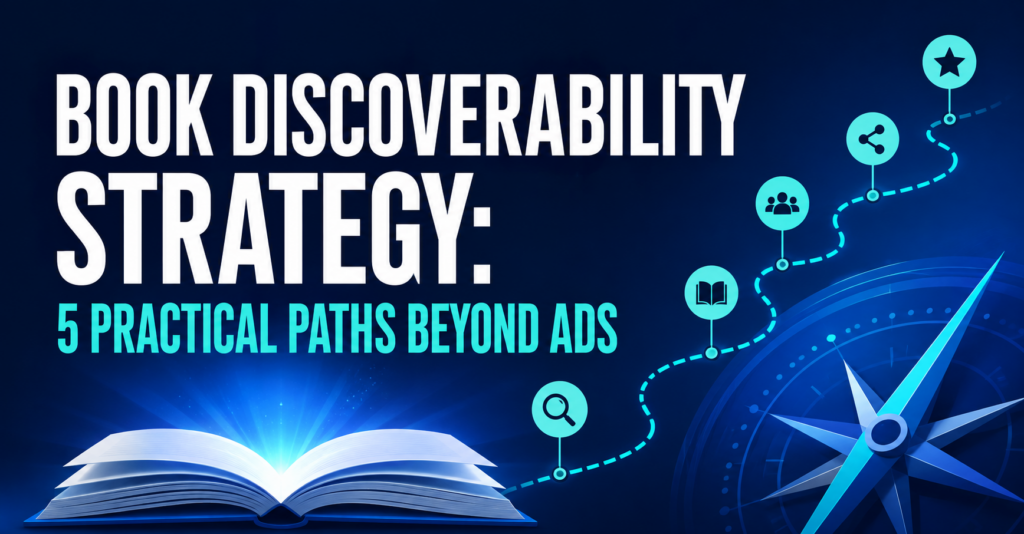

A book discoverability strategy is the connected path that helps a suitable reader notice your book, understand it, trust it, obtain it, enjoy or use it, and pass it on. Advertising can start that journey, but an advert cannot repair a confusing description, weak availability, a mismatched audience, or a book that gives readers no reason to return.
That is good news if you are tired of feeling that book marketing means spending more money or feeding more content into social platforms. You can improve discoverability by making the route between your book and its readers clearer.
Several publishing developments in late August 2026 illustrate this change. Google has introduced an interactive layer for eligible purchased e-books. Independent publishers are strengthening collective visibility through bookstore-based bestseller lists. Publishers are showing renewed interest in shorter fiction. Bookstore-led events continue to prove that community can move books in ways an algorithm cannot.
The shared lesson is simple: readers discover books through usefulness, trust, access, belonging, and recommendation. This article turns those ideas into five practical paths you can build around one book.
What a Book Discoverability Strategy Really Means
Discoverability is often confused with reach. Reach is the number of people who could see a message. Discoverability is the likelihood that the right person can find and recognize the book when it is relevant.
A broad social post may reach 10,000 people who do not read your genre. A librarian’s recommendation may reach 20 people who are actively looking for exactly what you wrote. The second route has less reach and far more useful discovery.
Think of the reader journey as five linked questions:
- Is this for me? The cover, title, description, category, and context create recognition.
- Can I trust it? Reviews, recommendations, presentation, credentials, samples, and community context reduce uncertainty.
- Can I get it my way? Formats, retailers, libraries, bookstores, delivery regions, price, and accessibility shape access.
- Will it deliver? Craft, usefulness, entertainment, structure, and production quality create satisfaction.
- Why would I share it? Emotion, identity, practical value, conversation, gifting, and easy sharing turn one reader into another route.
When authors say, “Nobody can find my book,” the broken point may sit anywhere along that chain. A book might be visible but unrecognizable. It might be attractive but difficult to order. It might be valuable but hard to navigate. It might delight readers but never invite them toward the next book.
Your first job is diagnosis, not more promotion.
Path 1: Make the Book Instantly Understandable
The first part of a book discoverability strategy is recognition. A reader should be able to grasp the book’s category, audience, and central promise quickly enough to decide whether to look closer.
This does not mean making every book predictable. It means giving originality a familiar doorway.
Start with a one-sentence reader promise
Complete this sentence:
This book helps or invites [specific reader] to experience [specific outcome, emotion, question, or journey] through [distinctive approach, subject, setting, or story].
For nonfiction, the outcome might be practical: “This guide helps first-time nonfiction authors turn specialist knowledge into a clear, credible book without losing their own voice.”
For fiction, the promise describes the reading experience: “This historical mystery takes readers into a close Welsh mining community where one family secret threatens the loyalties that hold the valley together.”
The sentence is not necessarily public copy. It is the test behind your cover, subtitle, description, categories, retailer keywords, website, and event pitch. If those elements point in different directions, discovery becomes harder.
Check your comparison shelf
Search the store, library catalog, or bookstore shelf where your ideal reader would expect to find the book. Choose five current, genuinely comparable titles—not only famous books you admire.
Record:
- Cover signals and typography
- Title and subtitle patterns
- Length and available formats
- Price range
- Categories and subject codes
- Description structure
- Review language readers repeat
- The promise each book makes in its first few lines
You are not looking for a design to copy. You are learning the visual and verbal language readers already use to navigate the category.
If your book breaks a convention, make that choice deliberate. A quiet literary cover on an action thriller may win design admiration while losing the correct reader. A clever nonfiction title without a clarifying subtitle may make sense only after someone already knows the subject.
Strengthen metadata where discovery actually happens
Metadata is not a one-time form completed before publication. It is the information that carries your book through retailer pages, distributor feeds, library catalogs, search engines, review platforms, and bookstore systems.
Check the exact title, subtitle, series name, contributor names, description, categories, keywords, publication date, language, territories, price, page count, audience, and formats across your major listings. Fix contradictions at the source platform or distributor where possible.
Avoid category stuffing. More categories do not automatically create more relevant visibility. Choose the most accurate path from broad subject to specific reader interest.
The aim is consistency: every signal should help a suitable reader say, “Yes, this is the kind of book I was looking for.”
Path 2: Make the Content Easier to Use and Revisit
Google’s August 27 launch of Expert Intelligence gives eligible owners of selected Google Play Books titles the ability to explore a purchased book within Gemini Notebook. Readers can ask questions grounded in the text and create items such as quizzes, infographics, and audio overviews. The launch includes more than 100,000 books, mainly trade nonfiction, from participating publishers. Google explains how purchased books work as trusted sources, while Publishers Weekly reports that possible future expansion may include self-published books.
Independent authors should not assume eligibility or rush into a future program without seeing its terms. Participation, compensation, attribution, reader data, territorial rights, and opt-in or opt-out rules matter.
The broader signal is already useful: a nonfiction book can increasingly behave like a working resource rather than a static object.
Design for the returning reader
Ask what a reader will want to find three weeks after finishing your book. It might be a process, checklist, definition, model, story, exercise, recipe, timeline, or source.
Help that reader with:
- Descriptive headings that make sense outside the immediate paragraph
- A detailed table of contents
- An accurate index for print and suitable digital navigation
- Chapter summaries or “remember this” sections
- Definitions near first use
- Worked examples for abstract ideas
- Checklists and templates
- Source notes and recommended next reading
- Consistent names for concepts and steps
These features improve accessibility and usefulness even if no AI tool ever touches the book.
Turn one book into a small knowledge system
Create supporting material that answers common reader needs without giving away the whole book. For example:
- A one-page worksheet that helps readers apply Chapter 3
- A book-club guide with six thoughtful questions
- A companion timeline for a historical book
- A printable checklist for a practical guide
- A pronunciation guide or character list for complex fiction
- A short video showing how to use a framework
- A source list updated after publication
Host the resource on a stable page you control. Invite readers to receive it by email only when the exchange is genuinely useful and the consent is clear.
The supporting material creates new searchable pages, gives partners something valuable to share, and helps readers turn reading into action. That is discoverability built on usefulness rather than interruption.
Protect the value while exploring new tools
Interactive reading features sit close to rights questions. Traditionally published authors should understand who can authorize new uses, what their contracts say about electronic editions and derivative products, and whether revenue or approval terms apply. Indie authors should read every platform agreement and keep copies of the terms in force when they opted in.
Do not rely only on a reassuring announcement. Record the platform, date, titles, rights, territory, payment, removal process, data access, and permitted outputs. A responsible experiment still deserves business records.
Path 3: Build Trusted Bridges to Suitable Readers
Readers rarely discover books in isolation. A recommendation usually travels through a person, institution, list, or community they already trust.
On August 28, Publishers Weekly marked the Independent Publishers Caucus’s tenth anniversary. The organization has 107 member publishers and has introduced Top 40 fiction and nonfiction lists based on sales at independent bookstores, with a children’s list planned. The profile explains how the caucus is connecting publishers, booksellers, and librarians.
Self-published authors are not automatically part of that system, but the principle is valuable: coordinated visibility and credible curation help smaller books compete for attention.
Choose relevance before audience size
A trusted bridge might be:
- An independent bookstore with a strong local or genre identity
- A librarian who curates a relevant collection
- A professional membership body
- A specialist newsletter or podcast
- A book club or reading group
- A teacher, trainer, counselor, historian, or practitioner
- A local museum, archive, venue, or community organization
- A fellow author whose readership genuinely overlaps
The best bridge already has a reason to care about the book. A regional history belongs naturally with local archives and libraries. A leadership book may suit an industry association. A cozy mystery may suit genre newsletters and themed book clubs. A children’s book may connect with teachers, librarians, and family events.
Make a useful offer, not a request for exposure
“Please promote my book” gives the other person work and risk. A useful proposal makes the reader benefit visible.
Try:
- A 30-minute talk tied to the organization’s current program
- A ready-to-use reading-group guide
- A short article answering a recurring audience question
- A themed display list that includes several authors, not only you
- Signed stock for a relevant local event
- A workshop with clear learning outcomes
- A carefully prepared review copy and concise trade information
- A cross-promotion in which both audiences receive something suitable
Keep the approach short. Explain why the book fits, who it helps, what you can provide, and what you are asking. Include ordering information and a professional link. Follow up once unless invited to continue.
Support community before you need it
Black Bookstore Day, first held on August 29, 2026, illustrates how discovery can grow from cultural work, local history, and shared activity. Publishers Weekly describes participating stores’ readings, openings, discounts, and community programs.
The lesson is not to attach your book to every visible event. It is to recognize that communities remember people who participate respectfully over time.
Attend events. Buy books. Share accurate information. Introduce readers to other writers. Learn what the organization is trying to achieve. When your work is genuinely relevant, the relationship will have context.
Path 4: Remove Access and Ordering Friction
A reader can want a book and still fail to buy it. Every extra obstacle reduces the value of the attention you worked to earn.
Check formats against reader preference
Your ideal reader may prefer paperback, hardback, large print, e-book, audiobook, library borrowing, signed copies, or direct bundles. You do not need every format on day one. You do need a reasoned priority.
Use reader messages, comparable titles, sales data, and the needs of your subject. A practical reference may benefit from print and e-book. A story-driven title may gain from audio. A local book may need signed print stock and bookstore availability. An accessible digital edition needs clean navigation and image descriptions where appropriate.
Test real ordering routes
Do not stop at “available worldwide.” Test the routes a real reader or bookseller would use.
- Search by title, author, and ISBN on major stores.
- Open each listing on a phone.
- Confirm that editions are correctly linked.
- Check delivery time and displayed price in important territories.
- Ask whether a bookstore can order the print edition through its normal supplier.
- Check the wholesale discount and return status you selected.
- Search a library catalog and understand how readers can request a purchase.
- Test direct checkout, tax, shipping, confirmation, and download delivery.
If a route is slow or commercially unattractive, do not promise it casually in outreach. Solve what you can and be transparent about what remains.
Match the call to action to the reader’s stage
Someone encountering you for the first time may not be ready to buy. Give them a smaller useful step: read a sample, download a guide, attend a talk, listen to an interview, or join a relevant email series.
A warm reader needs a clear purchase path. A finished reader needs the next book, discussion guide, review link, or newsletter invitation.
One generic “buy now” button cannot serve every stage. Create a small number of clear paths rather than a page crowded with competing options.
Path 5: Give Readers a Natural Reason to Share
Word of mouth is often treated as luck. You cannot command it, but you can make sharing easier and more meaningful.
Create a discussable experience
Shorter fiction is receiving fresh attention, according to The Bookseller’s August 28 report on slim fiction and changing attitudes toward short stories. The useful point is not that every author should write shorter books. It is that format can support a social reading experience.
A novella completed over a weekend may suit a book club. A short nonfiction guide can be used by a team. A story collection creates natural stopping points. A concise local book can become a gift.
Ask what conversation your format enables. Then make that conversation easier with questions, themes, background notes, a short author video, or a virtual visit option.
Offer specific sharing language
Readers often want to recommend a book but do not know how to describe it. Your one-sentence promise helps them.
Create honest, reusable language such as:
- “A useful guide for first-time authors who need a manageable publishing plan.”
- “A gentle mystery for readers who enjoy village settings and family secrets.”
- “A concise local history that would make a thoughtful gift for anyone with Rhondda connections.”
Do not script praise or offer incentives for positive reviews. Give readers accurate descriptive language and let their opinion remain their own.
Build the next step into the book
The final pages are valuable space. Include:
- A brief thank-you
- The clearest next book or resource
- A stable website address
- A reader-group guide link where relevant
- A polite, neutral review invitation
- Newsletter information that explains what the reader will receive
Keep links few and durable. A cluttered page can feel like an advertisement just when the reader has completed a satisfying experience.
A 90-Minute Book Discoverability Audit
You do not need to rebuild your author business this week. Use this focused session on one published or nearly finished book.
Minutes 0–15: Define the reader and promise
Write one specific reader description and the one-sentence promise. Avoid “everyone who loves a good book.” Name the interest, need, genre expectation, or life situation that makes the book relevant.
Minutes 15–35: Inspect first-contact signals
Open the cover thumbnail, description, retailer page, author page, sample, categories, and search result. Note contradictions, missing information, and anything that requires prior knowledge.
Choose one fix with the greatest likely effect.
Minutes 35–50: Test access
Check the main format and ordering route. Verify price, delivery, edition linking, ISBN, library request information, and direct links. Record one problem you can correct or explain.
Minutes 50–65: Identify one trusted bridge
List three possible bookstores, libraries, newsletters, podcasts, groups, or organizations. Choose the one with the closest audience fit—not the largest following.
Minutes 65–80: Create one useful asset
Draft a discussion guide, checklist, sample, event idea, expert article outline, or short trade sheet that makes the book easier for the bridge to use or recommend.
Minutes 80–90: Set one measure and one date
Choose a practical indicator: sample downloads, event registrations, bookstore orders, library requests, email sign-ups, direct sales, review completion, or replies from suitable partners. Set a review date four to six weeks away.
The output of the session is not a giant marketing plan. It is one repaired path, one appropriate bridge, one useful asset, and one measure.
What to Measure Without Drowning in Data
A book discoverability strategy needs evidence, but not every number deserves weekly attention.
Track the stages you can act on:
| Stage | Useful questions | Possible measures |
| Recognition | Do suitable readers understand the book? | Page clicks, sample opens, event interest, description feedback |
| Trust | What reduces uncertainty? | Review quality, partner responses, library or bookstore acceptance |
| Access | Can readers obtain the preferred edition? | Conversion, order failures, delivery complaints, format split |
| Experience | Does the book deliver its promise? | Completion comments, returns, reader emails, review themes |
| Sharing | Do readers carry it forward? | Referrals, gifts, book-club use, repeat traffic, next-book sales |
Do not compare unrelated channels only by volume. Ten sales from a specialist talk may bring better reviews, referrals, and future invitations than 50 discounted sales from an audience with weak fit.
Write a short monthly note: what you tried, who it reached, what happened, what you learned, and what you will change. This protects you from repeating activity simply because it looks busy.
To your publishing success
Alun Davies
LBDLibrary
Discover more from
Subscribe to get the latest posts sent to your email.