
The latest author discoverability trends are not simply telling you to post more, advertise more, or chase another platform. They point toward something more useful: readers find books when the content is easy to understand, trusted people help it travel, the format fits their lives, and the next step is clear.
That matters because discoverability is one of the most tiring parts of authorship. You can write a strong book, publish it professionally, and still feel that the right readers never see it. When that happens, the natural reaction is to increase promotion. Yet more activity will not repair a confusing promise, unsuitable audience, difficult ordering route, or weak reason to recommend the book.
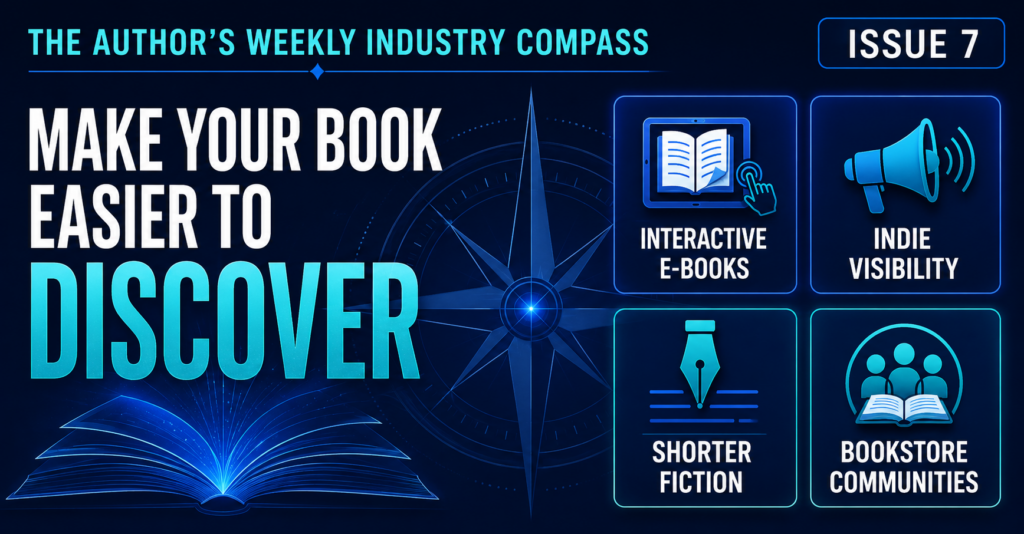
Issue 7 of The Author’s Weekly Industry Compass brought together five developments from late August 2026:
- Google made selected purchased e-books interactive inside Gemini Notebook.
- Independent publishers strengthened their collective visibility systems.
- Publishers reported renewed interest in short stories and slim fiction.
- The first Black Bookstore Day showed the power of community-led discovery.
- Several respected writing competitions approached their final August deadlines.
These may look like separate stories. Together, they show five different routes by which a book can become easier to find: usefulness, collective visibility, format, community, and opportunity.
This article expands each development and turns it into an action you can apply to your own writing or publishing work.
Why Discoverability Is More Than Reach
Reach tells you how many people might see something. Discoverability tells you whether a suitable reader can find and recognize your book when it is relevant.
A general social post may reach thousands of people who do not read your genre. A librarian’s recommendation may reach a small book club actively seeking exactly what you wrote. The second route has lower reach but better discovery.
A useful author discoverability system usually contains five stages:
- Recognition: The reader understands the category, audience, and promise.
- Trust: A sample, review, bookseller, library, expert, or community reduces uncertainty.
- Access: The reader can obtain the preferred edition in a suitable place and format.
- Experience: The book delivers what its presentation promised.
- Sharing: The reader has an easy reason and method to recommend, discuss, or gift it.
Each of this week’s developments strengthens one or more of those stages. Your goal is not to copy a large publisher’s campaign. It is to notice which stage is weakest for your own book and improve it.
1. Interactive E-books Reward Useful Structure
On August 27, Google launched Expert Intelligence with more than 100,000 eligible English-language titles from participating publishers. Readers who own a qualifying Google Play Books title can bring it into Gemini Notebook, ask questions grounded in the book, and create items such as quizzes, audio overviews, and infographics. Google explains the new feature in its official announcement.
The launch mainly covers trade nonfiction from publishers including Bloomsbury, Macmillan, O’Reilly Media, Penguin Random House, and Johns Hopkins University Press. Publishers Weekly reported that self-published books may be included later, while participation and opt-in or opt-out arrangements may depend on contracts and regions. Read Publishers Weekly’s August 27 report.
Why this matters to authors
The immediate feature will not be available to every author. Its wider meaning is more important: some readers increasingly expect a nonfiction book to behave like a resource they can question, search, summarize, and revisit.
A traditional linear reading experience still matters. However, a reader may return later for one process, definition, example, quotation, or checklist. If the content is difficult to navigate, much of the book’s long-term usefulness remains hidden.
Interactive tools may also change how readers judge structure. Vague chapter headings, inconsistent terminology, poorly labeled examples, and missing source notes make a book harder for both people and technology to use accurately.
Practical action: conduct a returning-reader test
Choose one nonfiction chapter and imagine that the reader finished it three weeks ago. They now need one specific answer.
Check whether the chapter provides:
- A descriptive heading that names the real subject
- Subheadings that separate stages or ideas
- Important terms defined near first use
- Consistent names for processes and models
- Worked examples rather than unsupported claims
- A short summary, checklist, or action section
- Source notes for facts and further reading
- Navigation that works in both print and digital editions
If the reader would have to reread twenty pages to locate one answer, improve the structure.
For example, “Chapter 6: Moving Forward” says very little. “Chapter 6: Choose Your Publishing Route” helps the reader predict the content. Subheadings such as “Traditional Publishing,” “Assisted Publishing,” and “Independent Publishing” make comparison easier.
Create one companion resource
Turn the chapter’s most practical element into a small supporting asset:
- A one-page checklist
- A decision worksheet
- A book-club guide
- A timeline
- A glossary
- A printable template
- A short demonstration video
The resource can live on a stable page you control. It gives readers a reason to return, helps partners share your work, and creates another relevant page through which new readers may find the book.
Protect your rights before opting in
New interactive features can create reader value, but you should still understand the agreement. If your publisher joins a program, ask who can authorize participation, whether the author receives compensation, what attribution is shown, what reader data is available, and how a title can be removed.
If independent authors become eligible later, save a copy of the terms in effect when you join. Record the selected titles, rights, territories, permitted outputs, payment arrangements, and withdrawal process.
Responsible experimentation and careful recordkeeping belong together.
2. Independent Visibility Grows Through Collaboration
Publishers Weekly released its 2026 Independent Publishing Issue on August 28. A central story marked ten years of the Independent Publishers Caucus, which now represents 107 member publishers. The organization has launched weekly Top 40 fiction and nonfiction bestseller lists based on independent-bookstore sales, with a children’s list planned. Read the Independent Publishing Issue overview and the caucus anniversary profile.
Why this matters to authors
Visibility is influenced by systems. Bestseller lists, trade coverage, bookstore databases, review channels, library selections, awards, and curated newsletters help decide which titles receive attention.
Large publishers can support these systems with extensive sales and publicity teams. Independent presses and self-published authors usually have fewer resources. Collaboration can create a level of visibility that an isolated campaign cannot.
The lesson is not that every self-published author can join a trade association designed for established presses. It is that collective discovery works when it connects good books with trusted recommenders and real reader behavior.
Practical action: map your trusted bridges
List the people and organizations your ideal reader already trusts. These may include:
- Independent bookstores
- Libraries and librarians
- Specialist newsletters
- Genre organizations
- Professional membership groups
- Podcasts and interview channels
- Book clubs
- Local museums or archives
- Teachers, trainers, counselors, or practitioners
- Authors with genuinely overlapping readerships
Do not begin with follower count. Begin with audience fit.
A local-history book may have a modest national audience but strong relevance to libraries, local societies, family-history groups, museums, and regional bookshops. A business guide may fit a specialist association better than a general book influencer. A cozy mystery may suit themed book clubs and genre newsletters.
Contribute before requesting promotion
Weak outreach asks someone else to “share my book.” Strong outreach offers a specific reader benefit.
You might propose:
- A short talk tied to an existing program
- A ready-to-use reading guide
- A practical article answering a common question
- A themed display list that includes several authors
- A workshop with clear outcomes
- Signed stock for an appropriate local event
- A polished review copy with concise trade information
- A cross-promotion that genuinely serves both audiences
Your message should explain why the book fits, what you can provide, how the audience benefits, and what you are asking. Include ordering information and one professional link.
Build a small collaboration habit
Each month, choose one action that supports the wider reading network:
- Recommend another suitable book.
- Attend a local event.
- Share accurate bookstore or library information.
- Introduce two people whose work fits.
- Invite a bookseller, librarian, editor, or author for a useful interview.
- Include a curated reading list in your newsletter.
This is not a quick exchange of favors. It is a reputation for being useful and connected. Over time, that reputation gives people a reason to notice your work as well.
3. Shorter Formats Can Match the Reader’s Available Time
On August 28, The Bookseller reported that publishers see a changing attitude toward short stories as readers embrace slim fiction. The report appeared alongside new collections and compact releases, including work by Samanta Schweblin. Read The Bookseller’s report on shorter fiction.
Why this matters to authors
Publishing advice often treats book length as a fixed rule. Yet readers choose formats partly according to time, price, purpose, and situation.
A novella may suit a weekend or book-club discussion. A short-story collection offers natural stopping points. A concise practical guide may help a reader solve one problem without committing to a 400-page reference book. A focused local publication may make a suitable gift.
The opportunity is not permission to publish work before it is ready. Shorter does not mean incomplete.
Practical action: define the complete promise
Write one sentence explaining what the reader will receive from the shorter work.
For fiction:
A tense, complete story about [character] facing [central conflict], designed to deliver [emotion or reading experience] in approximately [length or reading occasion].
For nonfiction:
A focused guide that helps [specific reader] complete [specific task] without covering [larger subjects intentionally excluded].
The exclusions matter. A concise guide becomes stronger when it owns its boundaries.
Choose the right role for the shorter work
A shorter publication might be:
- A complete standalone book
- A low-risk introduction to a fictional world
- A bridge between longer series titles
- A focused answer to one reader problem
- A companion to a larger book or course
- A seasonal or event-linked publication
- A premium reader magnet
- A direct-sales exclusive
Decide its role before setting the price, cover, distribution, and call to action.
Avoid three short-format mistakes
- Padding: Do not add repetition merely to reach an assumed page count.
- Under-explaining: A concise book still needs enough evidence, examples, context, or narrative development to feel complete.
- Misleading presentation: Make the approximate length and reading experience clear so buyers do not feel surprised.
Professional editing, cover design, formatting, metadata, and proofreading remain essential. A reader may finish a shorter book quickly, but they will notice quality problems just as quickly.
Test a shorter idea before producing it
Describe the concept to five suitable readers. Ask:
- Is this promise clear?
- Would this length suit the subject or story?
- Where would you expect to buy or borrow it?
- Would you read it in print, digital, or audio?
- What would make it feel complete?
Use their answers to shape the format, not simply to seek approval.
4. Bookstore Communities Create Trusted Discovery
The first Black Bookstore Day takes place on August 29, 2026. Led by Left on Read Bookstore co-owner Latasha Eley Kelly, the event celebrates Black-owned bookstores through readings, openings, discounts, storytimes, and community programs. Organizers intend it to return on the last Saturday in August. Publishers Weekly explains the event and its community purpose, and further information is available from Black Bookstore Day.
Why this matters to authors
A bookstore can be a retailer, but it can also be a place of cultural memory, recommendation, discussion, and belonging. Readers trust stores that understand their community and curate accordingly.
Authors sometimes approach bookstores as if the shop provides free promotional space. That misses the business pressures and community work behind the shelves.
A stronger relationship begins by asking how your book supports the store’s readers and program.
Practical action: prepare a bookstore-ready information sheet
Create a one-page document containing:
- Cover image
- Title, subtitle, author, and ISBN
- Publication date and formats
- Retail price
- Distributor and ordering details
- Wholesale discount and returns status
- Two-sentence reader description
- Relevant local, cultural, genre, or professional connection
- Review excerpts from credible sources, if available
- Event ideas you can support
- Your contact details and website
Keep the sheet factual and easy to scan. Do not fill it with general praise.
Offer an event that serves the store
“Can I have a signing?” puts the burden on the bookseller. A stronger proposal includes a subject, audience, structure, and promotional contribution.
For example:
I have written a local-history book about postwar life in the Rhondda. I can offer a 35-minute illustrated talk followed by questions, supply six archival-image discussion prompts, promote the event to my email readers, and provide signed stock through your normal ordering route.
The proposal tells the store what the event is, who may attend, and what the author will contribute.
Approach communities with relevance and respect
Your book may connect with a place, heritage, profession, age group, health experience, hobby, or cause. That connection does not automatically entitle you to attention.
Learn about the organization. Attend its events. Understand its priorities. Ask what would be useful. If the fit is real, offer something aligned with its purpose.
Community discovery grows through participation, not the extraction of an audience.
Follow up professionally
After an event or placement:
- Thank the organizer.
- Share agreed photographs or links.
- Report useful feedback.
- Settle stock and payment records promptly.
- Promote the store’s future work when relevant.
- Record what worked and what could improve.
A reliable author is easier to invite again.
5. Writing Competitions Need a Decision Process
At the end of August 2026, Poets & Writers listed several established competitions with August 31 deadlines. These included the University of Iowa Press Short Fiction Awards for debut collections, the Black Lawrence Press St. Lawrence Book Award, and the University of New Orleans Press Lab Prize. Rules, fees, eligibility, rights, and prizes differ. Browse the current Poets & Writers grants and awards listings.
The individual deadlines are time-sensitive and must be checked immediately before submission. The more lasting lesson is how to decide whether an opportunity deserves your work, time, and money.
Why this matters to authors
A suitable competition can lead to publication, money, professional feedback, recognition, or a useful credential. An unsuitable contest can consume fees and attention without supporting your goals.
Deadline pressure makes poor decisions more likely. Authors may submit an unfinished manuscript, overlook a rights clause, enter the wrong category, or pay because the prize sounds impressive.
A good opportunity should fit both the manuscript and your publishing plan.
Practical action: use a seven-question filter
Before submitting, answer these questions:
- Is the organizer established and verifiable? Check its history, named staff, prior winners, and publications.
- Is my work genuinely eligible? Confirm location, age, publication status, genre, word count, language, and previous-publication rules.
- Is the manuscript ready now? Do not confuse a deadline with readiness.
- Are the fee and likely benefit proportionate? Include preparation time as well as money.
- What rights am I granting? Look for publication, exclusivity, option, anthology, publicity, and withdrawal terms.
- What happens if I win? Check editing, publication timing, copies, payment, appearances, and conflicting commitments.
- Does this support my real goal? Publication, readership, credibility, feedback, money, or professional connection should be clear.
If a rule is uncertain, ask the organizer before paying.
Keep a submission record
Use a spreadsheet or simple table with:
- Opportunity and organizer
- Official URL
- Category
- Deadline and time zone
- Fee
- Manuscript version
- Date submitted
- Rights granted
- Expected decision date
- Result
- Follow-up action
Save the confirmation email, receipt, submitted file, and rules in effect on the submission date.
This record prevents duplicate submissions, missed decisions, and confusion over which manuscript version you sent.
Do not build a strategy around winning
Competition results depend on fit, taste, judges, and a strong field. Enter only when the ordinary outcome—no win—still leaves you comfortable with the cost and effort.
Treat a well-chosen competition as one route, not your publishing plan. Continue writing, querying, publishing, building readership, and seeking opportunities elsewhere.
How the Five Author Discoverability Trends Work Together
The five topics form a practical system:
| Trend | Discovery benefit | Author action |
| Interactive e-books | Makes useful content easier to revisit | Improve headings, examples, summaries, navigation, and companion resources |
| Independent networks | Creates collective credibility and visibility | Build trusted bridges and contribute useful material |
| Shorter formats | Matches specific reading needs and available time | Define a complete, focused promise and present the length clearly |
| Bookstore communities | Connects books with trusted local and cultural spaces | Prepare professional ordering information and reader-centered events |
| Writing competitions | Opens selective routes to publication and recognition | Use a clear eligibility, rights, readiness, and value filter |
Notice that none of these routes begins with “post every day.” Each begins with fit.
Interactive content must fit the reader’s need. A collaborative network must fit the audience. The format must fit the promise. A community approach must fit the organization. A competition must fit the manuscript.
Fit makes promotion more efficient because you stop asking uninterested people to care.
A Practical Five-Day Discoverability Plan
Use one short session each day. Work on one book rather than your whole catalog.
Day 1: Improve usefulness
Choose one chapter. Strengthen its heading, subheadings, key definition, example, and closing action. Create an outline for one companion resource.
Day 2: Identify trusted bridges
List five organizations, publications, stores, libraries, or people whose audience genuinely fits the book. Choose one and note how you could contribute value.
Day 3: Review the format
Ask whether the book’s present length and formats match the reader’s likely use. If you have another idea, test whether it could become a complete short work rather than an abbreviated long one.
Day 4: Prepare for bookstores or communities
Draft the one-page information sheet. Confirm ordering data, price, discount, returns, event ideas, and your relevant connection.
Day 5: Review one opportunity
Find one legitimate competition, award, festival, speaking event, library program, or submission call. Apply the seven-question filter. Submit only if the fit and readiness are both strong.
At the end of the week, you will have one improved chapter, one partner prospect, one format decision, one professional information sheet, and one considered opportunity.
Final Checklist
- ☐ A suitable reader can understand the book’s promise quickly.
- ☐ The content is easy to navigate and revisit.
- ☐ Important claims, examples, and sources are clear.
- ☐ At least one trusted bridge connects the book with its audience.
- ☐ Your outreach offers a reader benefit, not merely a request for exposure.
- ☐ The format and length match the promised experience.
- ☐ Retail, library, and bookstore ordering details are accurate.
- ☐ Community approaches are relevant and respectful.
- ☐ Competition entries pass the eligibility, rights, readiness, and value checks.
- ☐ You keep records of platform terms, outreach, events, and submissions.
Conclusion: Build Discovery Around Fit
The most useful author discoverability trends do not promise a shortcut. They show that books travel through connected experiences.
A well-structured book becomes easier to use. A useful author becomes easier for partners to recommend. A focused format becomes easier to choose. A respectful community relationship creates trust. A carefully selected competition places the right manuscript in a credible opportunity.
You do not need to pursue all five routes at once. Identify the one that best fits your current book and strengthen it this week.
Discoverability is not only about attracting a larger crowd. It is about helping the right reader recognize that your book belongs in their hands.
Discover more from
Subscribe to get the latest posts sent to your email.