
A book discoverability strategy gives your work more than one sensible way to reach the right reader. It does not guarantee attention, and it cannot turn every book into a bestseller. What it can do is remove avoidable barriers between someone becoming curious and deciding that your book is worth their time.
That distinction matters because discoverability can feel strangely personal. When a book receives little attention, you may assume that readers have rejected the writing. Often, they have not reached the point where they can make that judgment. They may not understand the promise, recognize the genre, find the right format, see a trusted recommendation, or know which book comes next.
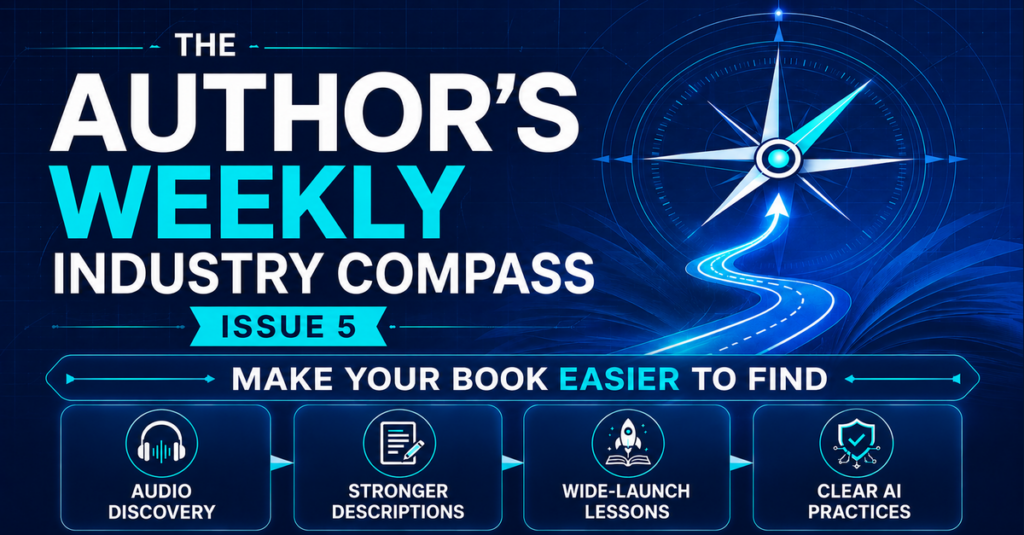
Several publishing developments this week show how those connections are changing. Spotify is adding conversational and playlist-based audiobook discovery. A debut indie author has shared a profitable wide-launch case study. New guidance explains why descriptions need emotional movement. European library access is consolidating around OverDrive’s Libby platform. Editors are also drawing firmer boundaries around AI-assisted material.
The stories are different, but they lead to one useful conclusion: your book discoverability strategy should make your book easy to understand, easy to place, easy to recommend, and easy to continue reading.
The seven moves below will help you build that path without chasing every platform or trend.
Table of Contents
- Start with the reader’s decision
- Build discovery into production
- Make the description create momentum
- Treat metadata as reader guidance
- Create more than one route to the book
- Earn trust before buying attention
- Keep your creative process explainable
- Put your strategy into action
- Frequently asked questions
Why a Book Discoverability Strategy Starts Before Promotion
Many authors treat a book discoverability strategy as work that begins after publication. The manuscript is complete, the files are uploaded, and only then does the question appear: how will people find this?
By that stage, several important decisions in your book discoverability strategy have already been made. The title, subtitle, cover, description, categories, formats, distribution arrangements, series information, and release timing all influence whether a reader recognizes the book as relevant.
A book discoverability strategy therefore begins during production. It connects the creative promise of the book with the practical signals that readers, booksellers, librarians, reviewers, and recommendation systems use to understand it.
This does not mean writing only for an algorithm. It means respecting the reader’s limited time. Someone should be able to see the cover, title, and first lines of the description and form a reasonably accurate expectation.
If that expectation is confused, promotion may simply send more people to a page that does not help them decide.
Move 1: Start with the Reader’s Decision
The strongest book discoverability strategy begins with a specific reader and a specific decision. “I want more sales” is understandable, but it does not tell you which obstacle needs attention.
Ask what must happen immediately before the result you want. If you want more audiobook sales, perhaps listeners need to encounter your title in a relevant playlist. If you want more series read-through, they may need clearer series numbering and a direct link to the next installment. If you want more newsletter subscribers, readers may need a useful reason to stay connected after finishing the book.
Define the useful result
Choose one result that you can observe over a realistic period:
- More qualified visits to the book page.
- A stronger percentage of sample readers who buy.
- Better read-through from book one to book two.
- More audiobook completions or follows.
- More library requests.
- More email subscribers from the back matter.
The result determines the work. More traffic might require partnerships or advertising. A weak conversion rate may point to the cover, description, reviews, price, or sample. Poor series read-through may require a better ending, clearer sequence, or stronger back matter.
Work backward from the hesitation
Picture a suitable reader arriving at your page. What might make that person hesitate?
They may not recognize the genre. The cover may promise a different tone. The description may begin with history rather than tension. The edition choices may be confusing. The price may feel unsupported by the presentation. There may be no reviews or no obvious connection to another book they enjoyed.
Your book discoverability strategy becomes more useful when it solves a real hesitation rather than adding more activity.
Move 2: Build Discovery into Production
Ashli O’Connell’s August 11 case study is a helpful example of a book discoverability strategy beginning early. Her debut self-published historical novel earned five figures in ten weeks without Kindle Unlimited, but the headline result came after months of preparation. She defined the standard she wanted, hired an editor and designer, built a small team, established online channels, and tested theme-led content before publication. Her account is worth reading in full.
No case study can promise the same outcome for another author. The transferable lesson is that production, positioning, and marketing were treated as one connected system.
Protect the promise of the book
Before commissioning a cover or writing marketing copy, complete a one-page positioning note:
- Who is the most likely reader?
- What familiar reading experience does the book offer?
- What makes this version distinctive?
- What emotion or useful change should the reader expect?
- Which comparable titles help explain its place?
- Which details must appear consistently across every format?
This note gives your editor, designer, narrator, formatter, and marketing helpers the same reference point. It reduces the risk that each person interprets the book differently.
Give yourself time to test
A practical book discoverability strategy includes enough time to learn. Share two description openings with a small reader group. Test whether people recognize the genre from the cover at thumbnail size. Notice which themes create thoughtful replies rather than empty reach.
Testing does not require a large audience. Ten suitable readers who explain their reactions can be more useful than hundreds of casual impressions.
Move 3: Make the Description Create Momentum
Your description is one of the few places where your book discoverability strategy and conversion meet directly. A retailer, librarian, reviewer, search engine, or recommendation tool may use its language to classify the book. A reader uses it to decide whether curiosity becomes action.
On August 12, Morgan Lee Clasper explained that a strong fiction description creates an emotional journey from curiosity to interest to action. It answers who the protagonist is, what is happening, and why the reader should turn the page. Her guidance includes clear before-and-after examples.
Lead with emotional context
A flat description often begins with facts: a job, age, place, historical period, or family relationship. Those facts may be accurate, but accuracy alone does not create momentum.
Lead instead with desire, fear, contradiction, threat, or transformation. “A retired detective lives alone in Cornwall” provides information. “After promising never to investigate another death, a retired detective finds a bloodstained notebook outside her cottage” creates a question.
The second version does not explain the whole story. It gives the reader a reason to continue.
Remove details that delay understanding
Writers naturally value the names, histories, systems, and subplots they created. Marketing copy has a different job. If a term requires a sentence of explanation before it becomes meaningful, it may not belong near the beginning.
For fiction, keep the protagonist, central pressure, emotional conflict, stakes, and open question. For nonfiction, identify the reader, frustrating problem, practical promise, and credible method.
Read the description aloud and mark the point where you feel the first genuine question. If that point arrives in paragraph three, move it forward.
Match the wording across discovery surfaces
Your book discoverability strategy becomes stronger when the same core promise appears on the retailer page, website, social profiles, media pitch, advertising copy, and back cover. The wording need not be identical, but the reader should meet the same book.
Move 4: Treat Metadata as Reader Guidance
Metadata can feel like administration, but it is really structured communication. It tells a store, library, platform, and reader what the book is, who created it, how it relates to other editions, and where it belongs.
Spotify’s August 11 announcement makes accurate audio metadata especially relevant to your book discoverability strategy. Its new tools include prompted audiobook playlists, conversational recommendations, and a next-in-the-series function in seven markets. Spotify describes all three discovery features here.
These tools may use far more information than authors can see or control. You can still make the information you supply accurate and consistent.
Create a master metadata sheet
Keep one approved record for every title and format:
- Title and subtitle.
- Series name and sequence number.
- Author and contributor names.
- Narrator name.
- ISBN or platform identifier.
- Publisher or imprint.
- Publication date.
- Categories and keywords.
- Short and long descriptions.
- Territorial and language details.
- Retail prices and library terms.
- Links to every live edition.
Use that sheet when updating platforms. Small variations in author names, subtitles, series wording, or dates can make editions harder to connect.
Check the path to the next book
Series discovery deserves a clear place in your book discoverability strategy. Confirm that the sequence is correct on every retailer. Put the series name and book number where the platform expects them rather than forcing them into unrelated fields.
At the end of each edition, include a direct and current route to the next title. If the next book is not available, invite the reader to a relevant mailing list rather than a generic homepage.
Good metadata does not replace good writing. It prevents good writing from becoming unnecessarily difficult to find.
Move 5: Create More Than One Route to the Book
Depending entirely on one retailer, format, or traffic source makes your book discoverability strategy fragile. A policy change, advertising increase, account problem, or recommendation shift can remove most of your reach at once.
A resilient book discoverability strategy creates several appropriate routes without requiring you to be active everywhere.
Consider retail, audio, and libraries separately
Readers use formats differently. Print may support gifting, events, local stores, and visual browsing. Ebooks offer immediate access and flexible pricing. Audio reaches listeners during travel, exercise, housework, and other moments when reading print is not practical.
The latest AAP annual report estimated that print still represented 73.1% of US trade publisher revenue in 2025, while trade digital-audio revenue grew 5.3% and ebook revenue grew 3%. These publisher-level figures do not predict an individual author’s results, but they show why format decisions deserve care. Publishing Perspectives reports the figures and methodology.
Release the formats you can produce professionally. Preserve rights you are not ready to use. Add another format when the audience and economics justify it.
Keep Libraries in Your Book Discoverability Strategy
Libraries can introduce your book to readers who would not risk buying an unfamiliar title. That makes library access a useful part of a book discoverability strategy, especially for series discovery and long-term visibility.
On August 12, OverDrive announced the acquisition of the company behind Onleihe, a digital-lending service that has operated across German-speaking markets since 2007. Users are expected to move toward Libby over time, although no transition date has been given. Read the acquisition details.
If your distributor supplies OverDrive, check availability, pricing, territories, and language metadata. If it does not, decide whether library access matters enough to add another route.
Build one channel you control
Retailers and social platforms rent you access to an audience. Your email list and website give you a more durable connection.
Offer a useful reason to subscribe: a reader magnet, bonus chapter, research notes, discussion guide, early notification, or occasional letter that matches the book’s interests. Make the invitation visible in the back matter and on your website.
The goal is not to capture every reader’s email address. It is to give interested people a simple way to continue the relationship.
Move 6: Earn Trust Before Buying Attention
Paid promotion can increase reach, but it cannot create trust by itself. The wrong audience, weak positioning, or an unconvincing book page can turn a large campaign into expensive noise.
Jane Friedman raised that question directly on August 12 in an article about whether authors can buy their way into influencer marketing. The public introduction asks whether paid access can lead to meaningful sales. The article is available to subscribers.
A practical book discoverability strategy uses paid attention after the message and audience are reasonably clear.
Test the connection before the price
Before paying an influencer, newsletter, podcast, or advertising platform, ask:
- Does this audience regularly buy books like yours?
- Can the promoter show engagement relevant to books rather than general reach?
- Will you know what was delivered?
- Can you track visits, clicks, samples, sales, or subscriptions?
- Does the campaign leave behind anything useful, such as reusable content or a new relationship?
- What result would make the cost worthwhile?
Large follower numbers can be comforting because they look measurable. Relevance, trust, and action matter more.
Start with earned and owned connections
The first partners in your book discoverability strategy may be existing readers, local groups, subject specialists, librarians, booksellers, reviewers, podcasters, and authors serving a related audience.
Approach them with a specific connection. Explain why the book fits their readers or conversation. Make it easy to assess by supplying a concise description, professional cover, publication details, suitable links, and a clear request.
Do not expect free labor or automatic support. Treat each contact as a relationship, not a distribution machine.
Move 7: Keep Your Creative Process Explainable
Trust now extends beyond the finished book. Editors, publishers, platforms, readers, and rights partners may ask how AI tools were used and who made the final creative decisions.
On August 13, editor Mary Kole described how undisclosed AI-assisted manuscripts required work beyond the editing scope she had priced. She revised her agreement to define substantial AI-generated content, require disclosure, clarify responsibility, and allow scope and fees to change. Her article explains the experience and shares sample wording.
Jane Friedman’s AI and Publishing FAQ for Writers was updated on August 14. It emphasizes that prompting alone does not create copyrightable authorship in AI output, while using tools for research, brainstorming, outlining, or editing your own work does not remove copyright from your human-written expression. Laws and policies continue to develop, and the guide is not legal advice.
Keep a simple process record
Your book discoverability strategy should not rely on claims about your process that you cannot support. Keep dated drafts, research notes, source records, editorial correspondence, and a short AI-use log.
For each tool use, record:
- The tool and date.
- The purpose.
- What material you supplied.
- What the tool returned.
- What you accepted, rejected, rewrote, or verified.
- Which human decisions shaped the final work.
This is not about producing a defensive file for an imaginary dispute. It is ordinary professional recordkeeping.
Ask service providers the same questions
If an editor, designer, narrator, translator, or marketer works on your book, ask whether your material will be submitted to an AI service. Confirm confidentiality, retention, training, ownership, disclosure, and approval terms.
Transparency should work in both directions. Reader trust is part of every sustainable book discoverability strategy.
Put Your Book Discoverability Strategy Into Action
A book discoverability strategy does not improve automatically when you add more options. Too many simultaneous changes make it difficult to learn what worked.
Choose one friction point this week:
- Rewrite the first two lines of the description.
- Correct inconsistent series metadata.
- Add a direct link to the next book.
- Confirm audiobook or library availability.
- Define the audience before purchasing promotion.
- Add an email invitation to the back matter.
- Start a simple AI-use and source log.
Complete that action, note the date, and decide which measure would show an improvement. Review it after a suitable period.
Then ask five questions:
- Can the right reader quickly recognize the book?
- Does the description create a clear emotional or practical reason to continue?
- Are every format and series connection accurate?
- Can readers find the book through more than one appropriate route?
- Can you explain the creative and professional process behind it?
A book discoverability strategy is not a document you complete once. It is a set of choices that becomes clearer as you observe real readers.
Frequently Asked Questions
What Is a Book Discoverability Strategy?
A book discoverability strategy is a practical plan for helping suitable readers encounter, understand, evaluate, and continue into your work. It connects positioning, packaging, metadata, formats, distribution, recommendations, promotion, and reader relationships.
Do I Need to Publish Wide to Improve Discoverability?
No. Exclusivity can be a deliberate business choice when its benefits match your audience and goals. Review what the arrangement provides, what routes it removes, and whether the trade-off still works. Avoid remaining exclusive merely because changing feels difficult.
How Important Is My Book Description?
The description is one of the most important conversion elements you control. It should establish the relevant character or reader, create emotional or practical tension, clarify the central promise, and give someone a reason to sample or buy.
Should Every Author Produce an Audiobook?
No. Consider audience demand, genre standards, production quality, narration, rights, cost, and likely income. Protecting the rights until you can produce or license audio well may be better than releasing a weak edition.
Are Libraries Useful for Indie Authors?
Libraries can strengthen a book discoverability strategy by introducing unfamiliar authors to readers, supporting series discovery, and extending a title’s reach. Availability depends on your distributor, territories, pricing, and the acquisition decisions of individual libraries.
Can Paid Influencer Marketing Solve a Discovery Problem?
Paid campaigns can amplify a strong match, but reach alone does not guarantee sales. Confirm audience relevance, deliverables, tracking, cost, and the quality of the book page before spending heavily.
Does Using AI Damage Book Discoverability?
The tool alone does not determine discovery. A responsible book discoverability strategy protects trust by avoiding undisclosed generated material, inaccurate claims, unclear rights, and weak voice. Keep human authorship central, verify the work, understand contracts, and maintain a clear record of your process.
Final Takeaway
You do not need to make your book visible to everyone. You need to make it easy for the right person to recognize why it belongs in their reading life.
A resilient book discoverability strategy combines a clear promise, professional presentation, persuasive description, accurate metadata, appropriate formats, trusted routes, and an explainable creative process.
Start with one reader hesitation. Remove it. Then watch what happens before adding more activity.
To your publishing success.
Alun – LBDLibrary.com
Discover more from
Subscribe to get the latest posts sent to your email.