
An author business strategy should give you more than one reliable route to readers. It should also help you protect your rights, make better use of the books you have already written, and choose new opportunities without feeling pulled in every direction.
That may sound ambitious when you are already writing, publishing, marketing, and managing the everyday work behind your books. The good news is that a useful author business strategy does not require you to be everywhere at once.
It begins with better choices.
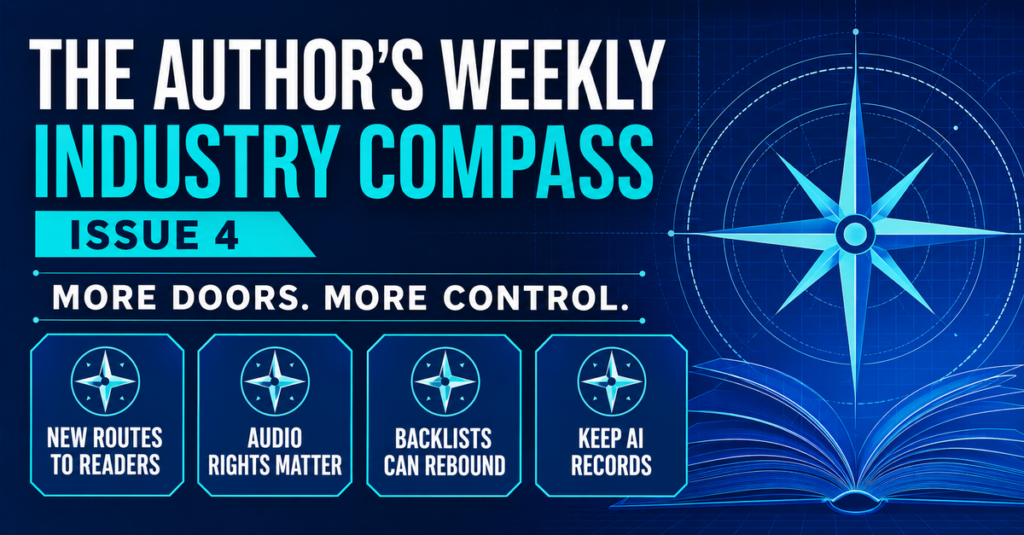
Several publishing developments this week show why those choices matter. Libro.fm is preparing to sell ebooks alongside audiobooks. A major audio publisher has acquired a successful multi-format independent press. Film attention has pushed older books back up the charts. Several publishers are accepting manuscripts without an agent. Updated AI guidance is also reminding writers that a clear, documented creative process matters.
These are separate stories, but they point toward one practical idea: your author business becomes stronger when it does not depend on a single retailer, launch, format, publishing route, or tool.
The following five moves will help you build that flexibility without creating unnecessary work.
Table of Contents
- Build wider routes to readers
- Treat audiobook rights as a business asset
- Give your backlist another chance
- Keep more than one publishing route open
- Make your AI process clear and explainable
- Put your author business strategy into action
- Frequently asked questions
Why Your Author Business Strategy Needs More Than One Door
Publishing decisions are often presented as either-or choices. Traditional or independent. Exclusive or wide. Ebook or audiobook. New release or backlist. Human-written or AI-assisted.
Real author careers are rarely that tidy.
You may publish one book independently and another through a small press. You may keep an ebook exclusive for a period while distributing print widely. You may license audio rights for one series and produce another audiobook yourself. Your approach can change as your experience, finances, audience, and priorities change.
That flexibility is not a lack of direction. It can be a sensible author business strategy.
The risk appears when a decision continues simply because it once made sense. A distribution arrangement may no longer suit your readership. An audio clause may control rights that have never been used. A backlist title may be sitting quietly while its subject becomes timely again.
Your task is not to change everything. It is to review the doors currently open to you and notice where one carefully chosen alternative could reduce your dependence or increase your reach.
Move 1: Build Wider Routes to Readers
When authors discuss wide distribution, the conversation often becomes a simple argument about sales. Will another retailer sell enough copies to justify the effort?
That question matters, but it is not the whole author business strategy.
Your author business strategy should also consider resilience, reader preference, and the cost of depending too heavily on one sales channel.
On August 7, Libro.fm announced that it plans to add ebooks to its audiobook platform. Its planned features include flexible credits for ebooks or audiobooks, digital advance reading copies, and LibroSync for moving between reading and listening. The company’s established model connects digital audiobook purchases with independent bookstores. Publishing Perspectives summarized the planned Libro.fm expansion.
For authors, another digital storefront can create several kinds of value:
- It gives existing readers another way to buy.
- It may introduce books to customers who prefer independent-bookstore channels.
- It connects ebook and audiobook discovery.
- It reduces dependence on one retailer’s policies and algorithms.
- It may create new options for advance copies and synchronized reading.
This does not mean every author should immediately abandon exclusivity. Kindle Unlimited can be valuable when your genre, series, release schedule, and reader habits fit its subscription model.
The stronger question is whether your current distribution choice is deliberate and regularly reviewed.
Review the Purpose of Exclusivity
If you are exclusive, write down the specific benefit you receive. It may be page-read income, stronger visibility within one ecosystem, simpler administration, or access to promotional tools.
This turns exclusivity into a measurable part of your author business strategy rather than an arrangement that continues without review.
Then set a review date. Compare that benefit with what you may be giving up elsewhere, including libraries, other retailers, independent bookstores, and readers who do not use your chosen platform.
An author business strategy works best when exclusivity is a measured decision rather than a permanent habit.
Make Every Format Easy to Recognize
If you publish widely, keep your metadata consistent across every format. Your title, subtitle, series name, author name, cover style, categories, and description should help a reader recognize that the ebook, print edition, and audiobook belong together.
Small inconsistencies can divide reviews, confuse search results, and make a series look less connected than it really is.
Create one master metadata sheet for each title. Record the approved wording, identifiers, prices, territories, categories, keywords, and links. That simple document becomes part of your author business strategy because it reduces mistakes whenever a new retailer or format becomes available.
Measure Reach as Well as Immediate Revenue
A small sales channel may still introduce your books to a useful reader community. Libraries, independent stores, specialist retailers, and subscription services can contribute discovery even when they do not immediately match your largest outlet.
Track income, but also watch email sign-ups, review activity, series read-through, library requests, and direct reader messages. These signs can reveal whether a distribution route is building longer-term value.
Move 2: Treat Audiobook Rights as a Business Asset
RBmedia’s acquisition of Boldwood Books is another sign that audio and general publishing are moving closer together. RBmedia announced that Boldwood will continue as one of its publishing divisions, with Amanda Ridout remaining chief executive. RBmedia’s August 4 announcement confirms that the transaction closed on July 31.
The lesson is not to predict what the acquisition will mean for individual Boldwood authors. It is to recognize the strategic value publishing businesses place on audio capability and multi-format rights.
Audiobook rights should therefore have a clear place in your author business strategy.
Even if audio is not affordable today, your author business strategy should explain whether you intend to preserve, produce, share, or license those rights later.
Know Exactly What You Are Granting
Before signing a publishing, production, or licensing agreement, identify:
- Which audio rights you are granting.
- The languages and territories covered.
- Whether the rights are exclusive.
- How long the publisher or producer controls them.
- Whether unexploited rights return to you.
- Whether the rights can be sublicensed or transferred.
- How royalties are calculated and reported.
- Who approves the narrator, production, and final files.
If a clause is unclear or commercially important, obtain suitable professional advice. A short explanation from someone who understands publishing contracts may protect a valuable asset for years.
Compare Three Practical Audio Routes
An indie author usually has three broad options.
First, you can finance and control the production yourself. This offers more control over the narrator, schedule, pricing, and distribution, but it requires money, time, and quality management.
Second, you can use a royalty-share arrangement. This reduces the upfront cost but may commit your rights and income for a long period. Make sure both parties understand marketing responsibilities and what happens if sales are lower than hoped.
Third, you can license the audio rights to a specialist publisher or producer. This reduces your workload and financial risk, but you give up some control and revenue.
There is no universal answer. A sensible author business strategy considers the likely audience, production cost, contract length, rights position, and your ability to support the release.
Do Not Produce Audio Only Because It Is Growing
Audio may be important, but a poor production can damage the reader’s experience. Before committing, listen to comparable books in your genre. Note their narration style, length, pacing, and pricing.
Estimate how many copies or listening hours would be needed to recover your costs. If the figures do not yet work, preserving the rights can be a perfectly professional decision.
Move 3: Give Your Backlist Another Chance
Many authors give nearly all their marketing energy to the newest book. That is understandable. A launch has deadlines, excitement, and a clear reason to communicate.
However, an effective author business strategy treats a backlist as a collection of working assets, not a shelf of finished projects.
That approach allows your author business strategy to create value from work you have already completed instead of depending entirely on the next launch.
Publishers Weekly reported that renewed interest surrounding The Odyssey lifted several related books during the week. Emily Wilson’s translation reached number two in the US market. The 1997 Robert Fagles translation rose 93%, while Madeline Miller’s Circe and The Song of Achilles increased by 128% and 82%, respectively. The August 7 Publishers Weekly bestseller report provides the figures.
Most authors will not benefit from a major film connection, but the underlying principle works on a smaller scale.
Your book may connect naturally with:
- A television adaptation or documentary.
- An anniversary or historical date.
- A recurring seasonal concern.
- A news story or public conversation.
- A renewed trend in your genre.
- A local event, exhibition, or festival.
- A new book that brings readers back to an established subject.
Start With Relevance, Not Promotion
Before you post a sales link, ask what your older book can contribute to the current moment. It may offer useful background, entertainment, a personal perspective, practical guidance, or a reading experience connected to a wider conversation.
Then create something that serves the reader: an article, reading guide, short video, interview, excerpt, discussion question, or updated resource page.
This makes backlist marketing feel less like repetition and more like useful publishing.
Avoid forcing your book into a sensitive news event merely because it is receiving attention. Readers can tell when a connection is genuine and when an author is borrowing attention without care.
Complete a Quarterly Backlist Review
Add a simple quarterly review to your author business strategy. For each book, check:
- Is the cover still competitive in its category?
- Does the description reflect what readers value most?
- Are the categories, keywords, and author links current?
- Is the price still appropriate across formats?
- Are there broken links or missing retailer pages?
- Is a new cultural, seasonal, or local connection emerging?
- Could the book support a bundle, series promotion, talk, article, or reader guide?
You do not need to refresh every title at once. Choose the book with the clearest opportunity and make one meaningful improvement.
Use Backlist Content to Support Your New Work
An older book can introduce readers to a new release when the subjects, characters, or themes overlap. Add an updated back-matter link, create a recommended reading order, or publish a short piece explaining the connection.
The benefit can also flow in the other direction. A new release may bring attention to an older title. Make that journey easy by keeping your website, retailer profiles, series pages, and email welcome sequence current.
Move 4: Keep More Than One Publishing Route Open
Agent representation remains an important route into traditional publishing, particularly for larger commercial publishers. It is not the only route.
Authors Publish identified nine presses open to direct submissions in August 2026. Their interests include children’s books, commercial fiction, romance, illustrated nonfiction, specialist subjects, poetry, and place-based writing. The editors warn that submission windows may close early and that writers should check fit carefully. The full August direct-submission list links to each publisher’s requirements.
A flexible author business strategy can include independent publishing, agent submissions, direct submissions, licensing, or different routes for different projects.
Your author business strategy can therefore change from book to book while still following clear standards for rights, costs, quality, and reader reach.
The presence of an open door does not mean you should walk through it. It means you have an opportunity to investigate.
Research Fit Before You Submit
Review at least three recent books from any publisher you are considering. Look at genre, tone, length, cover design, production quality, pricing, distribution, and the readers it appears to serve.
Read the submission instructions carefully. If the publisher asks for a synopsis, sample chapters, or a particular email subject line, follow those requirements exactly.
A carefully targeted submission demonstrates professionalism. It also protects your time.
Check How the Publisher Makes Money
A genuine traditional publisher normally earns by selling books to readers, not by charging authors to be published.
Some reputable businesses use different models, including partnership, assisted, or hybrid publishing. Those arrangements involve author payments, so you need to understand exactly what you are buying, which rights you retain, how distribution works, and what evidence supports any sales claims.
Do not rely on the label alone. Review the contract, costs, rights, responsibilities, exit terms, and realistic route to readers.
Your author business strategy should leave room for opportunity without making you vulnerable to an offer that depends on urgency or flattery.
Let Research Improve Every Publishing Path
Even if you decide not to submit, the research remains useful. Studying a focused publisher can improve your understanding of comparable titles, cover conventions, market positioning, and the language used to reach a particular readership.
That knowledge can strengthen a proposal, query, self-published edition, sales page, or marketing campaign.
Move 5: Make Your AI Process Clear and Explainable
The growth of AI-assisted writing tools has created confusion because copyright law, publishing contracts, platform rules, and personal ethics are connected but not identical.
Jane Friedman’s AI and publishing FAQ, updated August 7, separates many of these questions. It discusses current US positions on human authorship, AI-generated expression, prompting, research, editing, disclosure, licensing, and publisher practice. It also emphasizes that the law is evolving. Read the updated AI and Publishing FAQ for Writers.
The most practical response is not panic. It is documentation.
Clear AI records should be part of any author business strategy that uses these tools.
They give your author business strategy a practical standard for transparency, verification, and responsible creative work.
Create a Simple AI-Use Record
For each project:
- Keep dated manuscript drafts.
- Save your original notes, outlines, and research.
- Record each AI tool and the purpose for which you used it.
- Separate verified sources from generated summaries.
- Check factual claims against dependable sources.
- Preserve evidence of your own revisions and creative decisions.
- Record the platform, publisher, competition, or client rules that applied.
This record is not an admission that you did something questionable. It is ordinary professional documentation.
It helps you answer questions accurately, repeat a successful workflow, and distinguish your own contribution from a tool’s output.
Match the Level of Checking to the Risk
For brainstorming or testing an outline, a short note may be sufficient.
For nonfiction involving health, money, law, safety, current events, or identifiable people, the checking must be stronger. Verify every material claim and use qualified professional review where appropriate.
For creative work, keep the human decisions visible. Your voice, selection, structure, judgment, revision, and responsibility should remain central.
An author business strategy built on trust should never depend on publishing material you cannot explain or verify.
Read Every Disclosure Question Carefully
Copyright requirements, retailer policies, contest rules, and publishing contracts may ask different questions. Do not assume that one answer applies everywhere.
Read the exact wording. If necessary, ask for clarification and keep a copy of the answer.
Rules will continue to change. A clear project record makes it easier to respond without reconstructing your process months later.
Put Your Author Business Strategy Into Action
More options can strengthen an author business, but too many simultaneous projects can drain it.
Choose one manageable action for the coming week:
The best author business strategy is the one you can apply consistently, so begin with the action that offers the clearest benefit for the least unnecessary complication.
- Ask your distributor about forthcoming Libro.fm ebook availability.
- Review the audio clause in one publishing or production agreement.
- Reintroduce one backlist book through a genuinely timely piece of content.
- Research one suitable direct-submission publisher.
- Start a one-page AI-use record for your current manuscript.
Complete that action before adding another.
Then place a review date in your calendar. Your author business strategy should be a living set of decisions, not a document you create once and forget.
At each review, ask:
- Which route is serving readers well?
- Where am I too dependent on one company or format?
- Which rights am I actively using?
- Which backlist title has a fresh opportunity?
- Which tasks are producing useful results?
- What can I stop doing without harming the business?
These questions keep your strategy practical. They also help you avoid chasing every new platform or publishing trend.
Frequently Asked Questions
Does an Author Business Strategy Mean I Must Publish Wide?
No. Exclusivity can be a valid author business strategy when its benefits fit your books and readers. The important step is to understand the trade-off, measure the results, and review the decision regularly.
Should Every Author Produce an Audiobook?
No. Consider audience demand, production cost, contract terms, likely income, and the standard required in your genre. Preserving the rights until the timing is better can be a sound decision.
How Often Should I Review My Backlist?
A quarterly review is frequent enough to catch seasonal and cultural opportunities without creating constant maintenance. You can review high-priority titles more often around a new release or relevant event.
Can I Use AI and Still Protect My Work?
The answer depends on how you use the tool, the law that applies, and the rules of the publisher or platform involved. Keep human authorship central, document your process, verify information, and obtain appropriate advice when the legal or commercial risk is significant.
How Many Changes Should I Make at Once?
Start with one. A useful author business strategy reduces confusion rather than adding to it. Complete the clearest high-value action, assess the result, and then choose the next move.
Final Takeaway
You do not need to chase every new retailer, format, contract, promotion, or technology.
You do need to understand where your author career is overly dependent and where one additional option could give you more control.
A resilient author business strategy combines wider routes to readers, careful rights decisions, thoughtful backlist marketing, selective publishing opportunities, and a creative process you can explain with confidence.
Reviewing your author business strategy regularly will help you keep those choices aligned with your books, your resources, and the readers you want to serve.
Open one useful door this week. Then decide, without pressure, whether it leads somewhere worthwhile for you and your readers.
Discover more from
Subscribe to get the latest posts sent to your email.